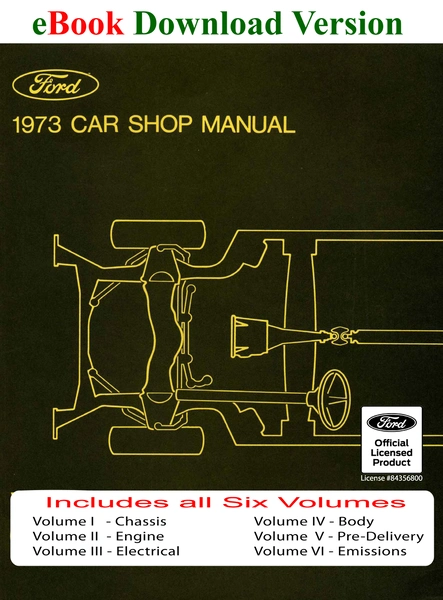
If you've ever found yourself staring at a 1973 Ford, wondering why the front end shimmies or why your bearings seem to fail prematurely, you're not alone. The early '70s were a fascinating transition period for American automotive engineering, and the 1973 Car Shop Manual Vol I-VI isn't just a repair guide—it's a masterclass in understanding the specific quirks and critical maintenance points that separate a garage queen from a reliable daily driver.
Why This Manual Matters More Than You'd Think
Here's something most classic car enthusiasts learn the hard way: modern repair knowledge doesn't always translate well to early '70s Fords. These vehicles had unique bearing adjustment specifications, tire compatibility rules that were actually safety-critical, and diagnostic procedures that don't follow today's computer-aided logic. The 1973 manual addresses these specific needs with original Ford engineering specifications that simply can't be found elsewhere.
Take wheel bearing adjustment, for instance. The manual emphasizes something that's caused countless headaches for restorers: there's a razor-thin line between too tight and too loose. Overtighten them, and you'll cook your bearings within a few hundred miles. Leave them too loose, and you're looking at uneven tire wear, steering problems, and compromised brake efficiency. The manual doesn't just tell you to adjust them—it explains the consequences of getting it wrong, which is exactly the kind of real-world insight that saves both time and money.
Decoding Your Ford's DNA
One of the manual's most valuable sections covers vehicle identification systems in exhaustive detail. That VIN plate near your windshield? It's not just a serial number—it's a treasure map. The manual breaks down every letter and number, revealing your car's assembly plant (was it built in Dearborn, Atlanta, or one of two dozen other facilities?), original engine configuration, transmission type, and even the sales district it was destined for.
This information becomes invaluable when you're sourcing parts or verifying authenticity during a restoration. Those engine codes—like "F" for the 302-2V or "L" for the 250-1V six-cylinder—help you identify exactly what you're working with, especially important since engine swaps were common even back then. The manual also includes separate coding systems for Canadian-market vehicles, which is crucial since Ford of Canada used different regional designations.
The Color and Trim Code Mystery Solved
Ever wondered what "Corinth vinyl" actually looked like, or whether your Mustang's interior is original? The manual includes comprehensive trim code references that read like a time capsule of early '70s automotive fashion. You'll find everything from the Cougar's corduory and leather combinations to the Continental's Westminster cloth options, each with specific alphanumeric codes.
These aren't just academic details—they're practical tools for restoration accuracy. When you're hunting down correct seat materials or verifying that a "numbers matching" car is genuinely original, these codes are your roadmap. The manual even distinguishes between bench, bucket, and split-bench configurations, helping you identify exactly what your car should have had when it rolled off the assembly line.
Critical Specifications That Can't Be Ignored
Here's where the manual earns its keep: it specifies that wheel hub nuts must be torqued to 70-115 ft-lbs and inspected regularly. Loose wheel nuts don't just cause vibration—they elongate stud holes, creating damage that's expensive to repair. Similarly, the manual's stern warning about tire mixing isn't just liability language. Combining radial, belted, and conventional tires on these vehicles genuinely affects handling and safety in ways that modern cars with electronic stability control might mask but that '73 Fords won't forgive.
This manual represents the accumulated wisdom of Ford's engineering department at a specific moment in automotive history. It's not just about keeping your classic running—it's about understanding these vehicles as they were designed to be understood, with the precise specifications and procedures that made them reliable when they were new.