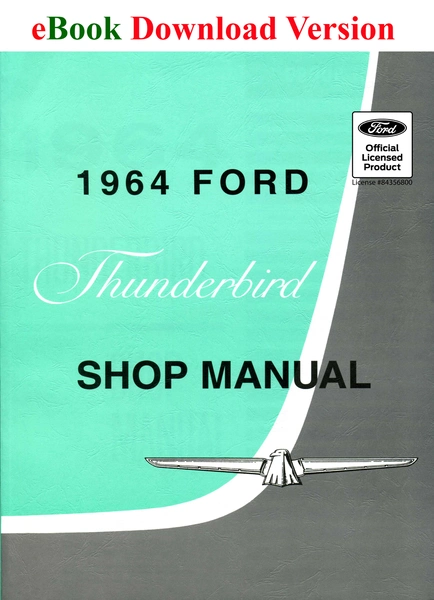
If you've ever wrestled with the brakes on a 1964 Ford Thunderbird, you know there's nothing quite like having the right information at your fingertips. The '64 T-bird represents a fascinating moment in American automotive history—it's the final year of the "Bullet Bird" generation, and while it's undeniably gorgeous, its systems can be remarkably complex for anyone used to working on simpler classics.
Why This Manual Is Different From Generic Repair Guides
Here's what makes the 1964 Ford Thunderbird Shop Manual genuinely essential: it's the actual documentation Ford dealership mechanics used, not a simplified aftermarket guide. That matters because the '64 Thunderbird featured systems that were cutting-edge for their time, including a vacuum-assisted brake booster with an automatic parking brake release—technology that can baffle even experienced mechanics if they don't understand how it's supposed to work.
Take the parking brake system, for instance. Most people don't realize that these Thunderbirds have a vacuum-powered automatic release that's integrated right into the transmission neutral safety switch. When you shift into drive, the system automatically releases the parking brake. Sounds simple, but when it malfunctions, you'll be scratching your head unless you understand the interaction between manifold vacuum, the actuating piston, and the pressure differential that makes it all work. The manual walks you through this entire system with the kind of detail you simply won't find anywhere else.
Decoding Your Thunderbird's Identity
One of the most practical sections covers vehicle identification, and it's not just academic. The VIN for title purposes isn't stamped where you'd expect—it's on the hood support top surface, not the warranty plate. The warranty plate itself is a goldmine of information if you know how to read it. Those cryptic codes tell you everything: "63B" means you've got a Tudor Landau, "G" indicates Prairie Tan paint, and "89" reveals Light Palomino Crinkle Leather interior. For anyone restoring a T-bird to original specifications or verifying authenticity before purchase, this information is invaluable.
The Self-Adjusting Brake Mystery Solved
Here's where the manual really shines with practical knowledge. The '64 Thunderbird's self-adjusting brakes operate on a clever cable-and-lever system, but there's a catch that trips people up: the adjustment only happens when you're braking in reverse. Why? The secondary shoe has to move away from the anchor pin to pull the adjusting lever upward, which doesn't occur during forward braking. If you're getting uneven brake wear or poor stopping power, understanding this mechanism helps you diagnose whether the self-adjuster is actually functioning.
The manual also emphasizes precision where it matters most. Master cylinder push rod adjustment requires no more than 0.015 inch piston movement—zero being ideal. Get this wrong, and your brakes will drag because the hydraulic pressure can't fully release. It's these specific tolerances and procedures that separate successful repairs from frustrating failures.
Real-World Troubleshooting That Actually Works
What really sets this manual apart is its systematic diagnostic approach. The brake troubleshooting section includes a complete matrix cross-referencing symptoms with causes—hard pedal, grabbing, dragging, you name it. When you're dealing with brake booster issues, it walks you through checking vacuum leaks, testing check valves, and inspecting diaphragms in logical sequence. There's even guidance on bleeding brakes properly: always start with the longest line first (right rear wheel cylinder), and never reuse drained fluid.
For anyone serious about maintaining or restoring a 1964 Thunderbird, this manual isn't just helpful—it's essential. You're not just getting repair procedures; you're getting the engineering knowledge behind why these systems work the way they do, which makes all the difference when something goes wrong.