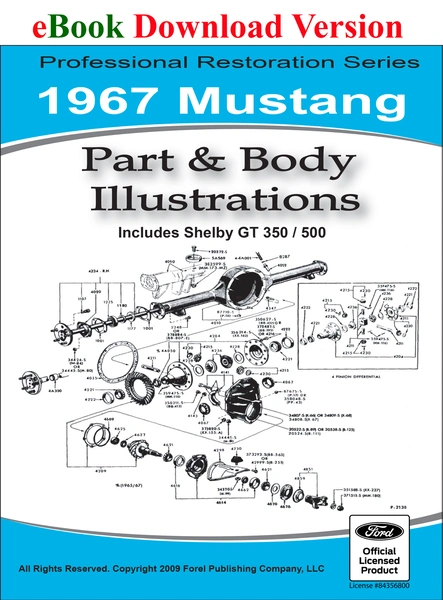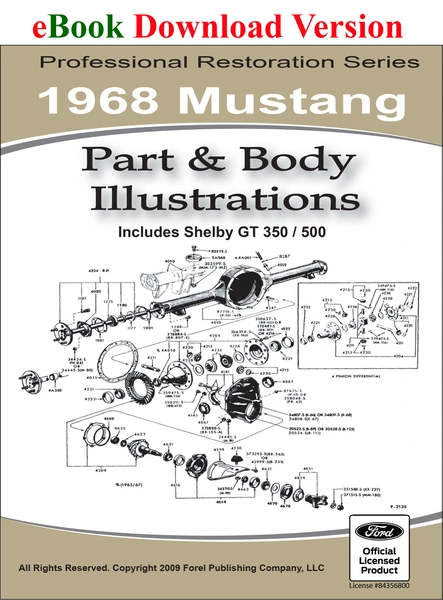
If you've ever worked on a classic Mustang, you know the frustration of staring at a stubborn assembly, trying to figure out which bolt goes where or how three different parts connect together. The 1968 Mustang Part and Body Illustrations manual exists to solve exactly that problem, and it's become an essential resource for anyone who's serious about maintaining or restoring these iconic ponycars.
Why This Manual Matters More Than You'd Think
Here's what makes this catalog special: it's not just a collection of pretty pictures. This is a reproduction of Ford Motor Company's original Master Parts and Accessories Catalog, the same reference materials that dealership mechanics used back in the day. We're talking about factory-level documentation that shows you exactly how Ford engineered these cars to go together. When you're trying to restore a '68 Mustang to original specifications, or you're just tired of guessing at part numbers, this is the reference that settles arguments.
What's particularly valuable is that this edition includes coverage of the Shelby GT350 and GT500 models. If you're working on one of these high-performance variants, you already know that parts availability can be challenging and expensive mistakes happen when you order the wrong components. Having factory illustrations that show the specific differences between standard Mustang parts and Shelby-specific pieces is worth its weight in gold.
How the Manual Actually Works
The catalog uses a smart triple-indexing system that'll make sense once you understand it. First, there's the numerical organization by illustration number (like P-4472), which follows Ford's original cataloging system. Then there's sectional grouping—for instance, Section 20 contains everything brake-related in one place. Finally, there's alphabetical indexing for quick lookups when you know exactly what you're searching for.
One quirk worth noting: pages are arranged numerically by illustration number, not alphabetically, so you'll need to use the index effectively. Some diagrams appear multiple times in the alphabetical index because they contain several major components. It might seem redundant at first, but this actually makes sense when you're searching for parts from different angles.
The Scope Is Genuinely Comprehensive
This manual covers an impressive range of engine configurations, from the economical 200 CID six-cylinder all the way up to the thundering 428 Cobra Jet V8. You'll find detailed illustrations for everything from pistons and crankshafts to carburetor assemblies and emission control systems (yes, Thermactor systems are fully documented). There's also complete coverage of transmission options—whether you're working with a three-speed manual, four-speed, or C4 automatic.
But it's not just mechanical components. The body panel illustrations are incredibly detailed, with separate diagrams for different body types (designated as 63, 65, and 76 in Ford's system). If you're doing metal work or need to identify the correct trim pieces, these exploded views show you exactly how everything fits together, which is invaluable when you're reassembling a car that's been in pieces for months or years.
Real-World Application
Where this manual really shines is during those head-scratching moments. When you're staring at a parts diagram that shows exactly which bracket connects the exhaust manifold to the heat riser valve, or you need to identify the correct fuel pump for your specific engine configuration, this is the reference that gives you confidence. It's saved countless restorers from ordering incorrect parts or making assembly mistakes that'd require expensive do-overs.
Whether you're a professional restorer or a weekend warrior bringing a barn find back to life, this manual provides the visual reference that makes complex jobs manageable and helps preserve these beautiful machines for future generations.