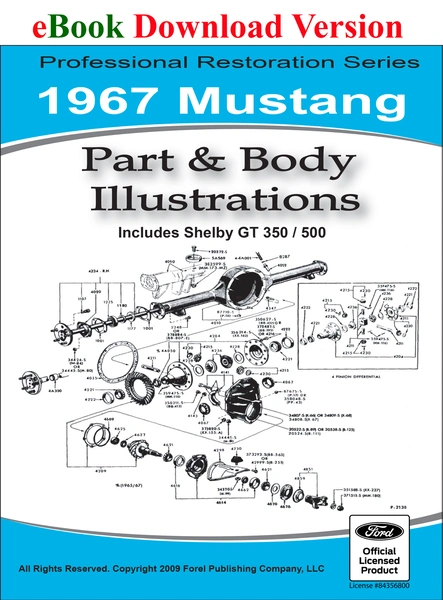
If you've ever torn into a 1967 Mustang restoration and found yourself staring at a pile of parts wondering exactly where that mysterious bracket goes, you're not alone. The '67 Mustang, while iconic, was built during an era when Ford was rapidly evolving these pony cars, and the sheer variety of configurations—from the base 200 cubic inch six-cylinder to the thundering 390 and 428 big blocks—means there's no one-size-fits-all approach to understanding these cars. That's where this parts and body illustrations manual becomes absolutely invaluable.
What Makes This Manual Different from Your Average Parts Book
Here's something most people don't realize: this isn't just a reprint of some generic parts catalog. It's sourced from Ford's actual 1965-72 Master Parts and Accessory Catalog, which means you're getting the same reference material that dealership mechanics used back in the day. Published by Forel Publishing Company in 2009, it preserves those factory-accurate illustrations that show exactly how Ford intended these cars to be assembled. For anyone chasing authenticity in a restoration, that's gold.
What really sets this manual apart is its triple-index system. You can search by illustration number (like P-4472), by section (such as Section 20 for brakes), or alphabetically by component. Why does this matter? Because when you're elbows-deep in a transmission rebuild at midnight, you don't want to flip through 200 pages to find the C4 automatic linkage diagram. You need it now, and this system delivers.
The Shelby Connection You Can't Ignore
One feature that'll make Shelby enthusiasts sit up and take notice: this manual includes coverage of the GT350 and GT500 models. These aren't afterthoughts, either. The index specifically calls out GT350/500 variations for everything from oil pans to seats. Given that authentic Shelby parts have become eye-wateringly expensive, having factory diagrams that show exactly what's different between a standard Mustang and a Shelby variant can save you from costly mistakes when sourcing reproduction parts.
Real-World Problem Solving
Let's talk about practical applications. Say you're rebuilding the front suspension on a '67 with power steering. The manual doesn't just show you the power steering pump—it illustrates the entire linkage system, mounting points, and how it differs from manual steering setups. Those exploded diagrams reveal the relationship between components that aren't obvious when you're looking at a greasy 50-year-old assembly under a car.
The engine coverage is particularly comprehensive, spanning everything from the humble 170 cubic inch six-cylinder all the way up to the 428 Cobra Jet. Each engine configuration gets its own detailed illustrations for critical components like oil pumps, valve trains, and crankshaft assemblies. This is crucial because Ford used different hardware across these powerplants, and installing the wrong push rod or using an incorrect flywheel bolt pattern can turn your project into a paperweight.
Why Every '67 Mustang Owner Needs This Reference
Even if you're not planning a frame-off restoration, this manual answers the questions that inevitably come up. What's the correct alternator bracket for a 289 with air conditioning? How does the emergency brake cable route on a fastback versus a coupe? Where exactly does that vacuum line connect on a Thermactor emission system? These aren't academic questions—they're the difference between a car that runs properly and one that's a constant source of frustration.
The manual's coverage extends beyond mechanical components too. Body panels, trim pieces, seats, and even radio installations are documented with part numbers and visual references. For anyone who's ever tried to figure out which of three similar-looking trim clips is correct for their specific body style, having these factory illustrations is like having a time machine back to the assembly line.
Whether you're maintaining a driver-quality Mustang or pursuing concours-level correctness, this parts and body illustrations manual bridges the gap between guesswork and certainty—and in the world of classic car restoration, that clarity is priceless.