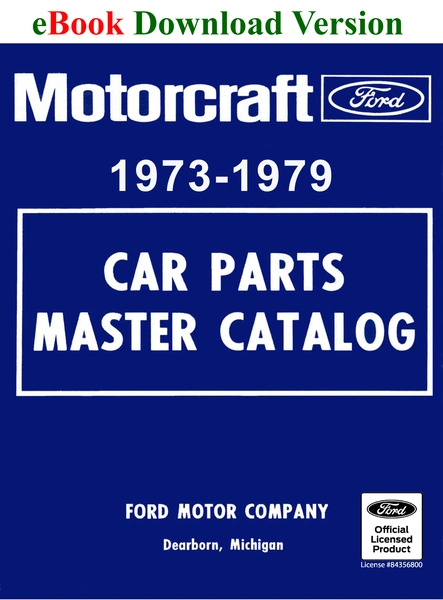
If you've ever tried to restore a mid-seventies Ford, you know the sinking feeling of staring at a mystery part with no clue what it's called, where it goes, or how to order a replacement. The 1973-79 Ford Car Parts and Accessories Catalog isn't just another dusty reference manual—it's the Rosetta Stone for anyone working on Fords from this transitional era in American automotive history.
Why This Catalog Matters More Than You'd Think
Here's the thing about seventies Fords: they're caught between two worlds. You've got carbureted engines meeting early emissions controls, traditional body-on-frame construction alongside Ford's experiments with lighter designs, and a dizzying array of trim levels that changed yearly. The 1973-79 period saw everything from the last of the big land yachts to the compact Fiesta, and Ford's parts numbering system reflects that complexity.
What makes this catalog particularly valuable is its comprehensive approach to part identification. Unlike modern computer systems that might give you three possible options, this catalog teaches you to decode your vehicle's warranty plate and certification label—skills that'll serve you for life. Those cryptic codes for assembly plants, paint colors, engine types, axle ratios, and transmission variants? They're all decoded here, turning what looks like random letters and numbers into actionable information.
The Devil's in the Details (And This Catalog Captures Them All)
One of the most frustrating aspects of working on classic cars is the "mirror image" problem with left and right parts. This catalog explains Ford's LH/RH designation system clearly—the driver's side is always considered left-hand. Simple, right? But knowing this prevents costly ordering mistakes. A part numbered D3SZ 2211-A isn't interchangeable with D3SZ 2212-A, even though they look nearly identical in photos.
The catalog's group numbering system is genuinely clever. The first two digits tell you the body type at a glance: 54 means four-door sedan, 62 indicates two-door sedan, 76 signifies convertible. This organization method means you're not wading through parts for every Ford model when you just need something specific for your '75 LTD Landau four-door.
Real-World Problem Solving
Let's talk about a common headache: identifying which 351 engine you've got. Ford made three distinct 351 variants during this period—the 351 Windsor, 351 Cleveland, and 351 Modified—and they're not interchangeable. This catalog documents the critical differences: valve cover bolt counts, front cover designs, thermostat housing orientations. These details matter when you're ordering gaskets or trying to source a replacement water pump at 9 PM before a weekend car show.
The catalog also includes accessory weight charts from 1975, showing exactly how various add-ons affect weight distribution between front and rear axles. This might seem trivial until you're troubleshooting handling issues or trying to maintain proper suspension geometry on a loaded-up Gran Torino wagon.
More Than Just Part Numbers
What separates this from a simple parts list is the context it provides. The detailed indexes cross-reference components by both name and numerical group codes. Looking for brake parts? They're indexed alphabetically and by their 2000-series group numbers. Need something for the cooling system? Check the 13000-range codes. This dual-indexing approach means you can find what you need whether you know the technical name or just the general system.
The inclusion of Motorcraft Sales Part Numbers alongside service part numbers is particularly helpful. When you see that asterisk marking, you know you're looking at retail packaging options, not just service department stock. For a carburetor air cleaner element, you might see both C20Z 9601-A and the Motorcraft number FA-3—giving you options for sourcing parts.
A Time Capsule With Practical Value
Working on these Fords today means dealing with parts that haven't been manufactured in decades. This catalog becomes your map to NOS (new old stock) treasure hunts and helps you identify compatible interchange parts. When someone's selling mystery Ford parts at a swap meet, you'll know exactly what you're looking at and whether it fits your project.
Whether you're keeping a survivor-grade '73 Mustang original or hot-rodding a '78 Fairmont, this catalog provides the foundation for making informed decisions. It's not about nostalgia—it's about having the right information when you need it most.