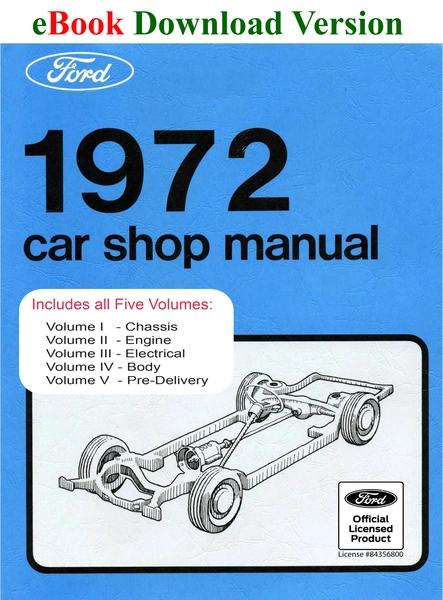
If you've ever stared at a classic Ford or Mercury from the early '70s and wondered what mysteries lie beneath that long hood, you're not alone. The 1972 Car Shop Manual isn't just a dusty relic—it's a remarkable time capsule that reveals how Ford engineered some of America's most iconic vehicles during a pivotal era in automotive history.
Why 1972 Was a Turning Point
The 1972 model year sits at a fascinating crossroads in automotive history. This was the last hurrah before stricter emissions regulations and safety standards fundamentally changed American car design. Ford's lineup that year was incredibly diverse—from the compact Pinto with its modest 98-CID four-cylinder engine to the massive Lincoln Continental powered by a thundering 460-CID V8. This five-volume manual covers them all, and that breadth tells you something important: these weren't cookie-cutter vehicles sharing a few basic platforms. Each model had distinct engineering challenges and solutions.
Decoding Your Classic Ford's DNA
One of the manual's most practical sections explains the Vehicle Identification Number system in detail. Unlike today's standardized VINs, the 1972 system was uniquely Ford, with consecutive unit numbers starting at different values depending on your car's lineage—100,001 for Ford, Mustang, and Pinto models; 500,001 for Mercury; and 800,001 for Lincoln. The Vehicle Certification Label on your driver's door area is like your car's birth certificate, encoding everything from paint color and interior trim to rear axle ratios and whether you've got that desirable locking differential.
Understanding these codes isn't just trivia—it's essential for restoration authenticity and can significantly impact your vehicle's value. That two-letter interior trim code tells you whether you've got Hopsack cloth, Morocco vinyl, or Natural Grain Leather, which matters tremendously when you're sourcing replacement materials.
Critical Maintenance Knowledge That's Still Relevant Today
The manual doesn't hold back on safety-critical information. There's a stern warning about front wheel bearing adjustment—get it wrong and you'll either cook your bearings from excessive preload or create dangerous wheel wobble from too much play. It's the kind of precise mechanical work that separates weekend tinkerers from serious restorers.
The tire wear diagnosis section is surprisingly sophisticated, showing how underinflation creates wear on the outer edges while overinflation concentrates wear down the center. These patterns help you catch alignment issues, suspension problems, or brake drag before they become expensive repairs. Remember, these cars had drum brakes at all four corners on many models, and the manual specifically warns about imperfect brake seals allowing lubricant contamination—a failure mode that could mean total brake loss.
The Space Saver Spare: A Forgotten Innovation
Here's something you don't hear about often: Mustangs could be equipped with an optional Space Saver spare tire that was stored deflated. This predecessor to today's compact spares came with its own inflator canister, and the manual's warnings about the inflator becoming "extremely cold during use" and sealant-based versions voiding the warranty show that even then, convenience features came with complications. It's a reminder that automotive innovation isn't linear—ideas emerge, disappear, and resurface decades later.
More Than Just a Manual
What makes this five-volume set invaluable isn't just the repair procedures—it's the window it provides into Ford's engineering philosophy during a golden age of American automobiles. Whether you're tracking down an electrical gremlin in your Torino, rebuilding the transmission in your Cougar, or simply trying to understand why your Galaxie handles the way it does, this manual speaks the original language of these machines. For anyone serious about keeping these classics alive, it's not just helpful—it's essential.