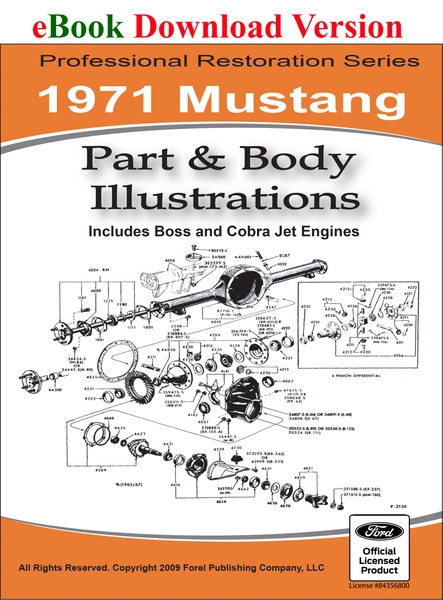
If you've ever stared at a disassembled 1971 Mustang wondering exactly where that mysterious bracket goes or how those three nearly identical-looking pieces fit together, you're not alone. The '71 Mustang represented a significant redesign year—Ford's largest Mustang to date—and with that size came complexity that can baffle even experienced restorers. That's precisely why the 1971 Mustang Part and Body Illustrations manual has become an essential reference that serious enthusiasts keep within arm's reach.
What Makes 1971 Such a Challenging Model Year
The 1971 Mustang wasn't just a refresh; it was a complete reimagining that added nearly eight inches in length and six inches in width compared to earlier models. This redesign introduced new body panels, revised suspension geometry, and accommodated a wider range of powerplants than ever before—from the economical 250 CID inline-six all the way up to the thundering 429 CID Cobra Jet. Each engine configuration required unique mounting systems, exhaust routing, and accessory layouts, which means there's no one-size-fits-all approach to working on these cars.
What's particularly tricky about '71s is that Ford was simultaneously dealing with the first wave of serious emissions regulations. You'll find Thermactor air injection systems and early electronic spark control components that didn't exist on earlier Mustangs. When you're trying to sort out vacuum line routing or identify which emission control valve belongs where, generic repair advice simply won't cut it.
How This Manual Solves Real-World Restoration Headaches
Here's where this particular manual shines: it's organized using three different navigation methods simultaneously. You can search by section (like Section 20 for brakes), numerically by diagram number, or alphabetically by component name. This might sound like overkill until you're elbow-deep in a project and can't remember whether the part you need is classified under "steering" or "suspension."
The manual covers an impressive range spanning diagram numbers 3742 through 6459, with comprehensive breakdowns of everything from the three-speed manual transmission to the C6 automatic, from disc brake assemblies to power steering components. It even includes the Boss and Cobra Jet engine specifications—critical information since these high-performance variants had unique oil cooler systems, exhaust manifolds, and engine mounting configurations that you won't find on standard models.
Why Factory-Sourced Illustrations Matter
This isn't someone's interpretation or hand-drawn recreation—it's compiled directly from Ford's original 1965/72 Master Parts and Accessory Catalog and reproduced under license. That authenticity matters tremendously when you're ordering parts or fabricating brackets. The exploded views show not just what connects to what, but the precise orientation, the correct fastener types, and the assembly sequence that Ford engineers intended.
For instance, if you're tackling the notoriously confusing interior trim installation on a '71 fastback (body type 63D) versus a convertible (76D), the manual breaks down the specific mouldings and attachment points unique to each body style. The same level of detail applies to the electrical systems—from alternator mounting variations across different engine sizes to the complex wiring required for factory air conditioning and power windows.
The Bottom Line for Mustang Owners
Whether you're doing a frame-off restoration or simply trying to troubleshoot why your Thermactor system isn't functioning correctly, having access to Ford's original engineering diagrams eliminates the guesswork that leads to stripped bolts, incorrectly routed hoses, and parts orders that don't fit. The 1971 model year represents a unique moment in Mustang history—the last of the truly big-bodied pony cars before downsizing began—and working on these machines requires documentation as substantial as the cars themselves. This manual delivers exactly that.