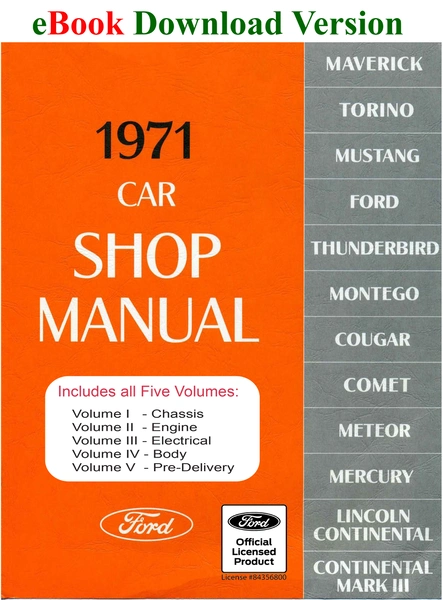
There's something remarkable about holding the same technical documentation that professional Ford mechanics relied on back in 1971. The five-volume Car Shop Manual from that year isn't just a historical artifact—it's a practical roadmap to understanding the mechanical DNA of some of America's most iconic vehicles. If you're working on a '71 Mustang, Torino, or Lincoln Continental, this manual offers something modern repair guides simply can't: the authentic factory specifications and procedures as Ford engineers intended them.
Decoding Your Classic Ford's Identity
Before you can properly service any vintage Ford, you've got to speak its language. The 1971 manual dedicates significant space to vehicle identification systems—and for good reason. That VIN stamped on the metal tab visible through your windshield isn't just a serial number. Combined with the certification label on the driver's door, it's a complete genetic blueprint of your car.
The manual breaks down every code you'll find on that label: engine displacement codes ranging from the economical 170 cubic inch six-cylinder all the way up to the mighty 460 CID V8, transmission types from three-speed manuals to various automatic configurations, and even rear axle ratios for both conventional and limited-slip differentials. Understanding these codes isn't academic—it's essential when you're ordering parts or diagnosing why your car doesn't perform quite right.
Interior Trim Codes: More Than Just Cosmetics
Here's where this manual gets unexpectedly useful for restoration enthusiasts. The extensive trim code reference guides document every interior configuration available in 1971, from basic vinyl to luxurious leather-and-vinyl combinations. Colors range from standard black and white to period-specific shades like "medium vermilion" and "dark tobacco." If you're trying to authenticate a restoration or return your Cougar to its original specification, these codes tell you exactly what upholstery materials and colors Ford installed at the factory.
Where the Rubber Meets the Road: Wheel and Tire Service
The manual's wheel service section reveals just how different maintenance was in 1971 compared to today's sealed bearing systems. Front wheel bearings on these cars use tapered roller bearings that require proper adjustment—not too tight, not too loose. Get it wrong, and you're looking at premature wear, overheating, or steering problems that'll have you chasing phantom issues for weeks.
There's also detailed coverage of the Space Saver spare tire system, which was innovative for its time. This deflated, compact spare maximized trunk space while still allowing normal-speed driving to a repair facility. But here's the catch the manual emphasizes: you needed Ford's specific inflator unit (part number C9WA-19F514-A), and the CO2 bottle would become dangerously cold during discharge. These practical warnings demonstrate why having the factory manual matters—it includes the real-world cautions that generic repair guides often miss.
System-by-System Technical Authority
What sets this five-volume set apart is its comprehensive, system-based organization. You're not getting condensed information or simplified procedures. The manual covers charging systems, lighting, brakes, steering, transmission, and every other component with the depth that professional technicians required. Each procedure includes the proper specifications, torque values, and special tool requirements that Ford engineers determined were necessary.
For anyone serious about maintaining or restoring a 1971 Ford, Mercury, or Lincoln, this manual represents something increasingly rare: unfiltered access to the manufacturer's original technical knowledge. It's the difference between guessing at the correct procedure and knowing exactly what Ford's engineers specified five decades ago.