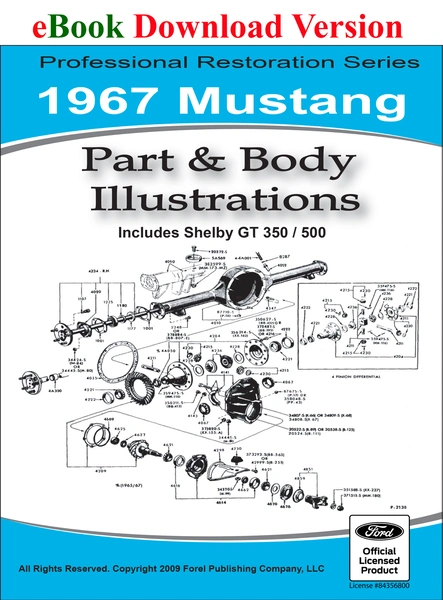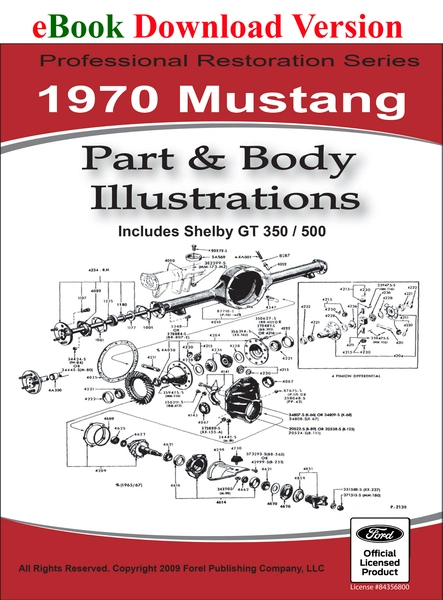
If you've ever stood in a parts store staring at a catalog, trying to figure out whether part number C9ZZ-4234-A is actually what you need for your 1970 Mustang's rear axle assembly, you'll immediately understand why Ford's original parts and body illustrations manual has become such an indispensable tool for serious restorers. This isn't just another parts book—it's essentially the decoder ring that unlocks the entire puzzle of what makes these iconic pony cars tick.
Why This Manual Matters for 1970 Mustang Owners
The 1970 model year represented a significant turning point for the Mustang. Ford had stretched the platform to accommodate bigger engines like the Boss 429 and 460 CID V8s, while still offering everything from economical six-cylinder models to high-performance Shelby variants. This diversity creates a real challenge when you're working on these cars decades later—what fits a base model won't necessarily work on a Boss 302, and Shelby GT350/500 components often differ entirely from standard Mustangs.
That's where this manual's genius really shines. Compiled from Ford's original 1965-72 Master Parts and Accessory Catalogs, it gives you the factory's own visual reference for how every single component should look and fit together. When you're trying to determine whether that transmission servo assembly you found online is correct for your C4 versus FMX transmission, having the original exploded diagrams makes the difference between ordering the right part and wasting money on returns.
How the Manual Actually Works
What makes this resource particularly valuable is its triple-indexed organization. You can hunt down parts three different ways: by Ford's original section groupings (like Section 20 for brake systems), by numerical illustration numbers (P-4472, P-2990, etc.), or alphabetically by component name. This flexibility is crucial when you're elbow-deep in a restoration and need information fast.
Let's say you're rebuilding your front suspension and can't figure out which steering pump pulley you need—there were different configurations depending on whether you had power steering, air conditioning, or various engine options. You can flip to the alphabetical index under "steering," locate the diagram number, and immediately see how your specific configuration should look, complete with every bolt, bracket, and bushing.
Real-World Applications That Save Time and Money
The manual's coverage spans everything from differential pinion assemblies to instrument panel components, covering both standard Mustangs and the distinctive Shelby models. This comprehensive approach means you're not constantly cross-referencing multiple sources or guessing whether aftermarket parts will actually fit.
Consider the Ram Air system documentation—these hood-mounted induction systems varied significantly across different engine packages, and incorrect reproduction parts are unfortunately common. Having the factory illustrations showing exactly how components stack together helps you spot incorrect reproductions before they're installed. The same goes for complex systems like the FMX transmission, where the manual breaks down clutches, servos, valve bodies, and controls with the kind of detail that makes diagnosis and rebuilding much more straightforward.
The Bottom Line for Restorers
Whether you're doing a concours-correct restoration where every fastener needs to be right, or you're simply trying to keep your driver-quality Mustang roadworthy, this manual eliminates the guesswork that makes classic car ownership frustrating. It's the difference between pointing at a diagram and saying "I need this exact part" versus describing what you think you need to a parts counter person who's never seen a 1970 Mustang.
For anyone seriously involved with these cars—from weekend warriors to professional shops—this manual represents the kind of foundational resource you'll reference countless times throughout a project. It's not glamorous, but it's absolutely essential for getting the job done right.