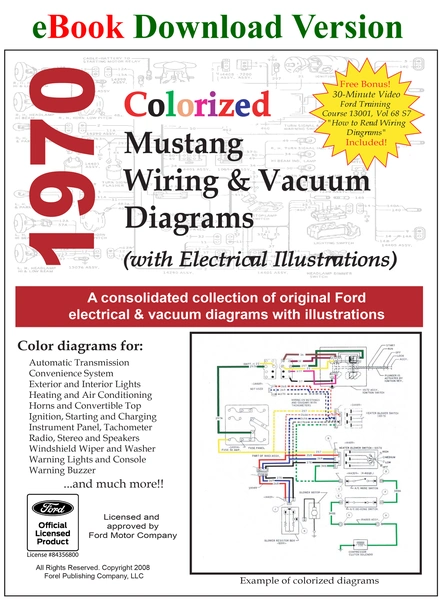
If you've ever stared at a tangled mess of wires under the dash of a 1970 Mustang, you know the feeling—it's like trying to solve a puzzle where half the pieces look identical. That's exactly why Forel Publishing Company's 2008 release of colorized wiring and vacuum diagrams has become such a valuable tool for anyone working on these classic pony cars. Originally published from Ford's own technical documents spanning 1969 to 1975, this manual transforms those notoriously difficult-to-read monochrome factory diagrams into something you can actually follow without developing a headache.
Why 1970 Mustangs Present Unique Electrical Challenges
The early '70s were a transitional period for automotive electrical systems. Ford was adding more comfort and convenience features—power windows, improved climate control systems, upgraded lighting options—which meant increasingly complex wiring harnesses. The 1970 Mustang sits right in that sweet spot where you've got enough electrical options to make troubleshooting tricky, but without the standardization that came later. That's where this manual becomes indispensable.
What makes this publication particularly useful isn't just the colorization—it's the comprehensive coverage. You'll find detailed circuits for everything from the transmission and ignition systems to instruments and climate control. The manual covers all 1970 Mustang variants, which is crucial because Ford offered numerous configurations that year, each with slightly different wiring schemes.
The Real-World Value: Understanding Circuit Tracing
Here's something most DIY mechanics learn the hard way: you can't just randomly test wires and hope to find the problem. The manual teaches you Ford's recommended approach—start at the ground of whatever component isn't working and trace backward toward the power source. This methodical technique saves countless hours of frustration.
The diagrams use what Ford calls an "open book" connector display, showing both halves of each connector as mirror images. Once you understand this convention, identifying which wire goes where becomes significantly easier. And here's a pro tip from the manual itself: if you're looking at a wire color that doesn't match what you're seeing in your actual car, don't panic. Ford occasionally had short-term manufacturing deviations where wire colors changed. The solution? Cross-reference other wires at the same connector to confirm you've got the right circuit.
The Training Video Makes All the Difference
Perhaps the most overlooked feature is the included 30-minute Ford training video from 1968. This isn't some modern recreation—it's the actual training material Ford used to teach its own service technicians how to read wiring diagrams. The video emphasizes that reading schematics is like reading a road map, a skill that's becoming increasingly important as vehicles gain more electrical features. For anyone who's never worked with automotive wiring diagrams before, this video alone is worth the price of admission.
What You Need to Know Before You Start
The manual includes important disclaimers you shouldn't ignore. Some wire colors have been altered for visual clarity, which means you'll occasionally need to cross-reference multiple diagrams if things don't line up perfectly. It's also worth noting that the publisher makes no guarantees about absolute accuracy—this is reference material, not gospel. For critical repairs, especially those involving safety systems, professional verification is always smart.
The wire identification reference table is particularly thorough, listing numbered wires from 2 all the way past 140, with their corresponding color codes and stripe patterns. Most come from Ford Form 7795P-70F, giving you factory-level detail about what each circuit should look like.
Whether you're doing a ground-up restoration or just trying to figure out why your turn signals don't work, having factory-accurate diagrams that you can actually read makes the difference between a weekend project and a month-long ordeal. For anyone serious about maintaining or restoring a 1970 Mustang, this manual isn't just helpful—it's essential.