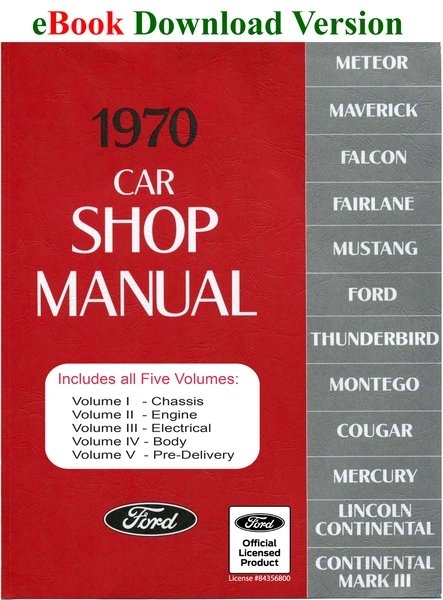
If you've ever tried hunting down the right specification for a 1970 Mustang's ignition timing or puzzled over a wiring diagram for a Thunderbird, you'll appreciate what made this five-volume shop manual series a game-changer. Ford completely redesigned how they organized technical information in 1970, and the results transformed how mechanics approached repairs on everything from the budget-friendly Maverick to the luxurious Continental Mark III.
Why Ford Revolutionized Their Manual System in 1970
Let's be honest—earlier Ford service manuals could be frustrating to navigate. You'd flip through hundreds of pages trying to find that one specification. The 1970 edition introduced a "group and parts" numbering scheme that's actually brilliant once you understand it. See a reference like 36-05-13? That's Volume 3, Group 6, Part 5, Page 13. This wasn't just clever organization—it was essential because these manuals covered such a diverse lineup. The same manual that detailed the Falcon's economical inline-six also covered the big-block engines in the Torino and the sophisticated electrical systems in Lincoln's luxury models.
Decoding Your Classic Ford: It's More Than Just a VIN
Here's something most casual enthusiasts don't realize: that aluminum VIN tab on your driver's side dashboard near the windshield tells only part of the story. The real treasure is the Vehicle Certification Label, which contains separate codes for body style, paint color, trim material, rear axle ratio, and transmission type. This matters tremendously for restoration work.
For example, the manual shows that interior trim codes like "1A" or "5K" represent specific material combinations—vinyl versus cloth and knit, black versus ivy green or ginger. If you're restoring a '70 Cougar and wondering whether your interior should be leather and vinyl or all-vinyl, these codes tell you exactly what rolled off the assembly line. The paint codes are equally specific, with designations like "3075-A" identifying colors such as Medium Avocado Metallic—that quintessentially early-'70s hue you either love or you don't.
What Sets This Manual Apart for Hands-On Work
The real value isn't just identification codes—it's the comprehensive coverage of systems that commonly give these classics trouble today. The ignition and electrical sections are particularly crucial because 1970 was a transitional era. You're dealing with pre-electronic ignition systems that require proper point gap settings and timing procedures. The vacuum system diagrams alone are worth their weight in gold if you've ever stared at the maze of vacuum lines under a '70 Mustang's hood and wondered where they all connect.
The manual also includes wheel balancing and front bearing service procedures that apply across all models. These aren't complicated modern assemblies—they're straightforward mechanical systems that you can actually service yourself if you've got the proper specifications. That's what this manual provides: the exact torque specs, clearances, and adjustment procedures Ford engineers specified.
One Manual, Nine Distinct Model Lines
What's remarkable is the scope here. We're talking about covering the Maverick (Ford's brand-new compact), the outgoing Falcon, the muscle-car Mustang and Torino, the personal luxury Thunderbird and Cougar, the family-hauling full-size Fords and Mercurys, plus Lincoln's Continental and Mark III. These weren't badge-engineered clones—they represented genuinely different platforms, engines, and technologies. The manual handles this complexity by separating information into distinct volumes while maintaining consistent formatting throughout.
Whether you're troubleshooting a no-start condition, restoring originality down to the correct interior materials, or simply maintaining one of these classics for weekend drives, this manual provides the factory-backed information that keeps guesswork out of the equation. It's the difference between hoping you've got it right and knowing you do.