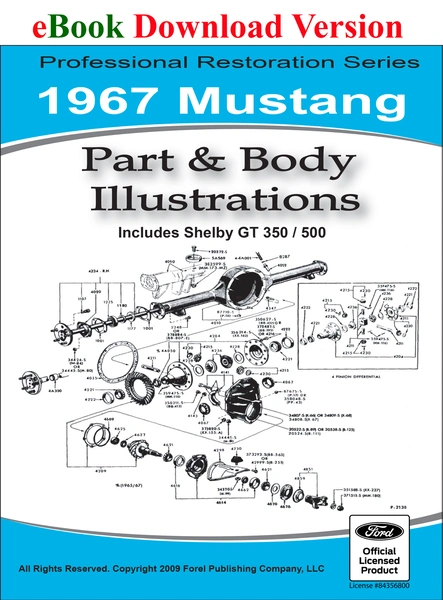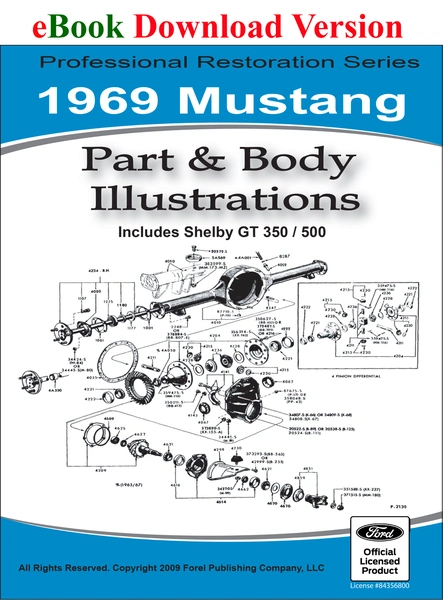
If you've ever tackled a 1969 Mustang restoration, you know the frustration of hunting down the right part number or trying to figure out how that mysterious bracket actually mounts. Here's the thing—Ford's parts illustrations from this era weren't just pretty pictures. They're the Rosetta Stone of classic Mustang restoration, and this professionally reproduced manual brings that critical information back to life for modern enthusiasts.
Why 1969 Mustangs Demand Special Documentation
The 1969 model year was a pivotal transition period for the Mustang. Ford significantly redesigned the body, making it longer and wider than previous generations, which means parts aren't universally interchangeable with '65-'68 models. What's more, this year saw an explosion of engine options—from the economical 200 cubic-inch six-cylinder all the way up to the thundering 428 Cobra Jet. The manual covers everything from standard models to the legendary Shelby GT 350 and GT 500 variants, which had their own unique components that you won't find on regular Mustangs.
This complexity is exactly why having accurate parts diagrams is essential. When you're trying to source a correct pinion differential or figure out the proper accelerator linkage configuration for your specific engine, guessing isn't an option.
Three Ways to Find What You Need
What sets this manual apart is its smart organization system. You can locate parts three different ways: by Ford's original section groupings (Section 20 for brakes, for example), numerically by illustration numbers, or alphabetically by component description. This isn't just convenient—it's practical problem-solving. If you're rebuilding your brake system, you can work through Section 20 systematically. But if you need to identify a specific mystery part you found in your trunk, the alphabetical index becomes your best friend.
The numerical index alone spans hundreds of entries, from part 3734 through 7000-plus, covering transmissions (manual 3-speed, 4-speed, and automatic C4/C6/FMX types), fuel systems, air conditioning components, interior elements, and virtually every mechanical system on the car.
The Devil's in the Details—And So Is Success
Let's talk about transmissions for a moment. The manual doesn't just show you a transmission—it provides exploded diagrams of clutches, gears, valve bodies, servos, and bands for multiple transmission types. When you're rebuilding a C4 or FMX transmission, you can't afford to mix up components or install parts in the wrong sequence. These illustrations show you exactly how everything fits together, just as Ford intended.
The same goes for engine components. With diagrams covering everything from 6-cylinder distributors to intake manifolds for various V8 configurations (including the Boss series and GT 500 variants), you're getting factory-level accuracy. This matters tremendously when you're trying to maintain originality for a numbers-matching restoration or simply want your engine to run as Ford engineered it.
Compiled from Original Ford Catalogs—Not Recreations
Here's something worth noting: this 2009 Forel Publishing manual isn't someone's interpretation or hand-drawn recreation. It's compiled from original 1965-72 Ford Motor Company master parts catalogs and reproduced under license from Ford itself. That means when you're looking at a diagram of sheet metal, exhaust systems for different engine configurations, or the electrical wiring for a convertible top, you're seeing the same information Ford dealers and mechanics relied on when these cars were new.
Whether you're a professional restorer tracking down correct body panels and trim for a show-quality build, or a weekend enthusiast trying to solve that persistent oil leak, this manual delivers the visual roadmap you need. It's not just about having information—it's about having the right information, with the part numbers and assembly context that turn a frustrating guessing game into a straightforward repair.