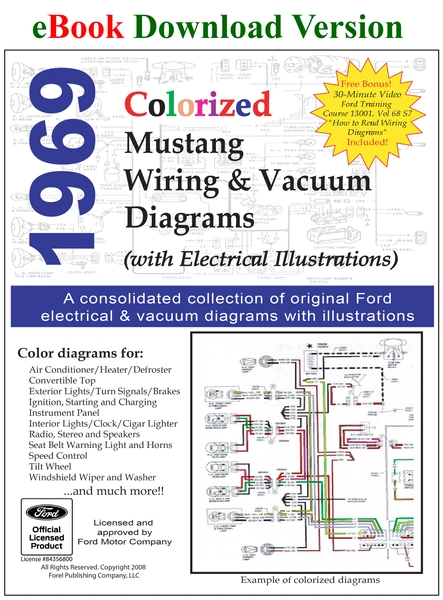
If you've ever worked on a classic 1969 Mustang, you know that electrical troubleshooting can quickly turn from exciting restoration work into a frustrating guessing game. The first-generation Mustangs are beloved for their style and performance, but their electrical systems—particularly in '69 models with options like air conditioning, power accessories, and premium stereo equipment—can be surprisingly complex. That's where this colorized wiring and vacuum diagram manual becomes absolutely invaluable.
Why 1969 Mustangs Need Special Attention
The 1969 model year was significant for Mustang enthusiasts. It marked the end of the first generation with styling updates that made it longer, lower, and wider than previous years. More importantly for electrical work, '69 Mustangs came with an expanding array of optional equipment—from factory air conditioning to convertible top motors to upgraded instrument panels. Each option added layers of complexity to the wiring harness, and Ford's original black-and-white diagrams don't always make it easy to trace circuits through these systems.
What makes this manual particularly useful is that it consolidates diagrams from multiple original Ford publications spanning 1968-1975. Instead of hunting through various factory service manuals, you've got everything in one place with the added benefit of color coding that wasn't available in Ford's original documentation.
Understanding the Wiring Variations Challenge
Here's something critical that many DIYers don't realize: Ford's published wiring diagrams don't always match what's actually under your hood. The manual addresses this head-on, explaining that you should cross-reference multiple diagrams to find matches with your specific vehicle. This happens because Ford made running changes during production—minor wire color variations that occurred during short manufacturing runs but never made it into updated diagrams.
The solution? The manual provides a comprehensive wire identification reference table listing numbered wires with their color and stripe descriptions, sourced from multiple Ford documents (Forms 7760-69 and FD-7795P-69). When you find a connector where one wire doesn't match the diagram exactly, you can identify it by comparing the other wires at that same connector. It's this kind of practical troubleshooting advice that separates useful manuals from mere collections of diagrams.
Real-World Application: Systematic Troubleshooting
The manual doesn't just throw diagrams at you—it teaches a methodology. For vacuum systems (critical for controlling everything from headlight doors to HVAC functions), it recommends starting with the total systems schematic to identify branch systems sharing the same vacuum source, then tracing from the control unit to the vacuum source and finally to the operating unit. This systematic approach saves hours of random testing.
For electrical diagnosis, all relays and switches are shown in the "system off" position, which is crucial for understanding circuit behavior. The manual explains that colored connectors aren't just decorative—they're specifically included to help you identify and trace circuits during testing, while standard disconnects remain black.
What's Actually Inside
The coverage is comprehensive: charging systems with detailed alternator testing procedures (including the warning to always disconnect the battery ground cable before removal since the alternator output is constantly hot), complete heater and air conditioning wiring with circuit protection specifications, lighting circuits, ignition systems, instrument panels, convertible top motors, and factory stereo installations. There's even a standardized symbol guide explaining every electrical component representation, which is essential since Ford used different symbols than many aftermarket manuals.
The vacuum diagram section is equally thorough, covering all Ford and Mercury models from that era, which is helpful because many systems were shared across the corporate family.
The Bottom Line
While the manual includes appropriate liability disclaimers (it's for general reference, not a substitute for professional help when you're in over your head), it's compiled from official Ford training courses and factory documentation. For anyone seriously working on a '69 Mustang—whether you're doing a complete restoration, diagnosing an electrical gremlin, or just want to understand your classic pony car better—this colorized manual transforms an often-intimidating task into something manageable. It won't make electrical work simple, but it'll certainly make it clearer.