If you've ever tried tracking down a mysterious brake issue on a classic Mustang or decoding the cryptic numbers stamped on a Cougar's door jamb, you'll understand why the 1968 Ford Shop Manual isn't just another dusty repair guide—it's the Rosetta Stone for anyone serious about maintaining these legendary machines.
When Ford Built Cars That Mechanics Could Actually Understand
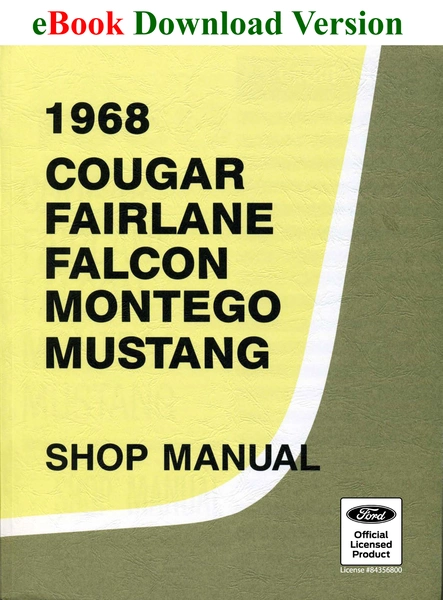
The late 1960s represented a sweet spot in automotive history. Cars were sophisticated enough to be exciting, yet mechanical enough that you could still diagnose problems without plugging into a computer. The 1968 Ford Shop Manual reflects this perfectly, covering five distinct models—Cougar, Mustang, Fairlane, Falcon, and Montego—during what many consider the golden era of American performance cars. Published by Forel Publishing under Ford's license and printed in November 1967, this manual hit dealer service departments just as these vehicles were rolling off assembly lines.
Cracking the Code: Why VIN Decoding Matters More Than You'd Think
Here's something most classic car owners don't realize until it's too late: that seemingly random string of numbers and letters on your car's VIN plate tells you exactly what you're working with. The manual provides comprehensive decoding charts that reveal your engine configuration, transmission type, rear axle ratio, and even which assembly plant built your car—whether it rolled out of Dearborn, Atlanta, or the Ontario Truck facility.
Why does this matter? Because a 302 cubic inch V8 has completely different service requirements than a 427, and knowing whether you've got a C-4 or C-6 automatic transmission isn't just trivia—it's essential information when you're ordering parts or diagnosing problems. The manual even breaks down District Special Order (DSO) codes, helping you trace whether your vehicle was built for Boston's sales district or destined for export markets.
The Devil's in the Details: Brake System Diagnostics
Let's talk about something every owner of these classics eventually faces: brake problems. The manual gets remarkably specific here, and it's this level of detail that separates authentic Ford documentation from generic repair guides. For instance, it specifies that brake fluid must be within 1/4 inch of the master cylinder reservoir top, and—here's the crucial part—you can't just throw any brake fluid in there. Ford mandates their Extra Heavy Duty fluid (the blue-colored stuff, Part C6AZ-19542-A), and they're serious about not mixing fluid types.
The troubleshooting procedures for dual master cylinder systems walk you through the entire diagnostic process, from checking the brake warning lamp to centralizing the differential pressure valve. If your brake pedal travel exceeds specifications, the manual recommends a surprisingly simple first step: perform sharp reverse and forward stops to activate the self-adjusters. It's this kind of practical, experience-based wisdom that you won't find in modern repair databases.
Interior Codes and Paint Colors: The Restoration Goldmine
For restorers, the paint and interior trim code sections are worth their weight in gold. The manual documents original color combinations with alphanumeric codes—everything from Gold Met and Vermillion exterior paints to the various cloth and vinyl interior combinations. Knowing that your Fairlane originally came with Pastel Parchment Vinyl with Ivy Gold accents isn't just about authenticity; it's about preserving automotive history.
Why This Manual Still Matters Today
Modern scan tools and online forums have their place, but when you're staring at a 55-year-old parking brake equalizer that won't adjust properly, there's no substitute for the exact procedure Ford engineers developed. The manual's parking brake adjustment instructions—specifying 100 ft-lbs break-away torque at the rear wheels—give you measurable targets rather than vague "feels about right" guidance.
Whether you're maintaining a weekend cruiser or doing a ground-up restoration, this manual represents something increasingly rare: comprehensive, manufacturer-specific documentation created by the people who actually designed these vehicles. It's not just a repair guide—it's a direct line to Ford's engineering department circa 1968, and that's information you simply can't replicate from generic sources.