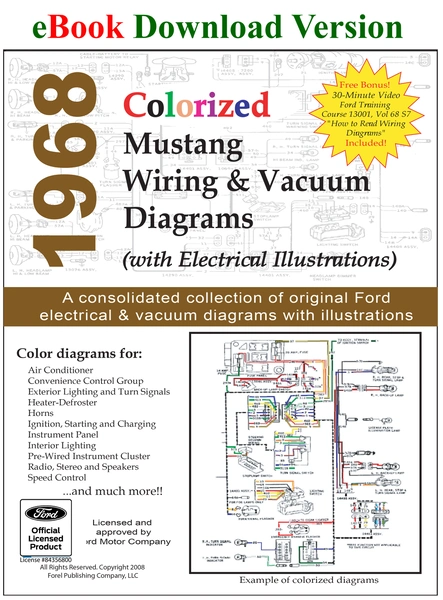
If you've ever stared at a rat's nest of wires under the dash of a 1968 Mustang, you know that sinking feeling. Which wire goes where? What's that mystery connector supposed to plug into? And why do half the wires seem to be the same color? Welcome to the world of vintage Ford electrical systems, where even experienced mechanics can find themselves scratching their heads.
The 1968 Colorized Mustang Wiring/Vacuum Diagrams manual exists because Ford's original electrical documentation, while technically accurate, wasn't exactly user-friendly. Back in 1968, automotive electrical systems were becoming increasingly complex. Air conditioning, multiple lighting circuits, speed control, sophisticated ignition systems—all of these added layers of complexity that made tracing circuits a genuine challenge.
Why Colorization Matters More Than You'd Think
Here's something that'll frustrate you if you don't know it upfront: Ford's wiring color codes weren't always consistent between different 1968 Mustang models. The manual actually warns users to cross-reference multiple diagrams if the wire colors don't match what they're seeing under their hood. This inconsistency wasn't Ford being careless—it reflected running changes during production, different suppliers, and variations between base models and those equipped with optional packages.
The colorized diagrams solve a problem that's plagued restorers for decades. Original Ford schematics were black and white with color codes written as abbreviations. When you're tracing a circuit through multiple connectors and splices, stopping to decode "BK-Y" (black with yellow stripe) every few inches gets old fast. Color-coded diagrams let your eyes follow the actual visual path of wires, making troubleshooting dramatically faster.
What's Actually Inside This Manual
This isn't just wiring diagrams slapped together—it's compiled from multiple original Ford publications from 1968, including shop manuals and technical service documents. You'll find complete coverage of the charging system, lighting circuits, ignition systems, instrument clusters, radio wiring, and yes, those temperamental speed control systems that seemed to have a mind of their own.
The manual includes something particularly valuable: a comprehensive legend that explains every electrical symbol and convention Ford used. It'll teach you the difference between normally open and normally closed switches, SPST versus DPST configurations, and how to read connector designations. There's even a section borrowed from a January 1968 Ford training booklet that was originally designed to teach dealership technicians how to read wiring diagrams. This wasn't public-facing documentation—this was internal training material.
The Fine Print You Should Know
The manual's publisher includes an important disclaimer: those red-highlighted wire color codes indicate actual discrepancies between different Ford publications. In other words, Ford's own documentation sometimes contradicted itself. This isn't the manual's fault—it's documenting a historical reality. When Ford published multiple service documents throughout a model year, wire colors could change without all documentation being updated simultaneously.
This is why the manual emphasizes that it's providing general information and recommends consulting qualified professionals for serious electrical work. It's not covering its backside—it's being honest about the complexity of working on 50-plus-year-old vehicles where previous owners may have made undocumented modifications.
Who Actually Needs This Manual
If you're restoring a '68 Mustang to factory specifications, you'll need this. If you're troubleshooting why your taillights work but your brake lights don't, you'll need this. If you're trying to install period-correct accessories and need to tap into the right circuits without creating electrical gremlins, you'll definitely need this.
Even if you're just maintaining a driver-quality '68 Mustang, understanding the electrical system prevents expensive mistakes. Modern mechanics often struggle with vintage electrical systems because they're trained on computerized diagnostics. This manual bridges that gap, providing the roadmap that makes these systems logical rather than mysterious.