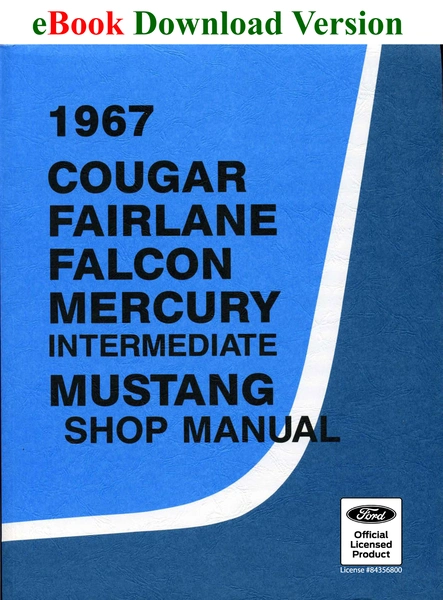
If you've ever cracked open the hood of a 1967 Mustang or Cougar, you already know these machines have character—and quirks. The 1967 Ford shop manual isn't just another dusty repair guide; it's your backstage pass to understanding what Ford's own technicians used when these cars rolled fresh off the assembly line. This was the era when Ford was flexing its muscle car dominance, and this manual covered everything from the sporty new Mercury Cougar to the workhorse Falcon, all sharing similar DNA under the sheet metal.
Why This Manual Still Matters Six Decades Later
Here's something you won't find in modern repair databases: the complete VIN decoding system that tells you exactly where your car was born. Mercury and Comet models stamped their numbers on the radiator support, while Cougars and Mustangs wore theirs on the left front fender apron. The manual breaks down those cryptic body serial codes—those two-digit numbers and letter suffixes that reveal whether you've got a base model or something special. When you're authenticating a classic or tracking down correct parts, this information is gold.
But it's the engine coding that really gets interesting. Ford offered a dizzying array of V8 configurations in 1967, from the tame 289 two-barrel to the fire-breathing 427 with eight velocity stacks. The manual doesn't just list specs—it explains how transmission types (C4 vs. C6 automatics) and rear axle ratios were coded, including how to identify the difference between conventional axles and locking differentials. Try finding that information clearly laid out anywhere else.
Real-World Problems This Manual Solves
Let's talk about something that plagues every classic Ford owner: brake issues. The manual dedicates serious space to brake system diagnostics, and there's a reason why. It covers the proper brake fluid specifications—and here's a critical detail that's saved many headaches: disc brake-equipped models required a specific blue-colored Rotunda Extra Heavy Duty fluid. Using the wrong stuff? You're asking for trouble.
The brake pedal adjustment procedure is particularly valuable because it's systematic. You're not guessing—you measure pedal travel under a precise 50-pound load, and if it's out of spec, the manual walks you through the diagnosis tree. Sometimes it's as simple as performing sharp reverse-forward stops to activate the self-adjusters. Other times, you're digging into drums, linings, and linkage. The manual even specifies different adjustment procedures for Mustang-Cougar versus Comet-Falcon-Fairlane models, targeting that exact 100 ft-lbs break-away torque at the rear wheels.
The Devil's in the Details
What makes this manual indispensable is how it handles the small stuff that'll make or break a repair job. Take the push rod adjustment: you need 0.015 inch movement or less—preferably zero—when contacting the master cylinder piston. That's the kind of precision spec that prevents comeback jobs. Or the brake bleeding sequence: always start with the longest line first, keep those reservoirs topped off, and never reuse old fluid. These aren't suggestions; they're the difference between brakes that work and brakes that fail.
The manual also includes Ford's complete manufacturing plant codes and distribution district information. Whether your car came from the Dearborn plant (F) or San Jose (R), it's all documented. Even the paint and trim codes are here—essential when you're doing a period-correct restoration and need to know that code 1724-A means Black or that your interior should be 3K Aqua vinyl.
More Than Just Instructions
This manual represents Ford at its engineering peak in the muscle car era. It's organized the way mechanics actually work—by system groups like brakes, engine, transmission, and electrical—with specifications and special tool requirements at the end of each section. You're not wading through fluff; you're getting straight technical information that assumes you're serious about the work.
For anyone who owns or works on these classic Fords, this manual isn't optional reading—it's your primary reference. It's the difference between guessing and knowing, between trial-and-error and getting it right the first time.