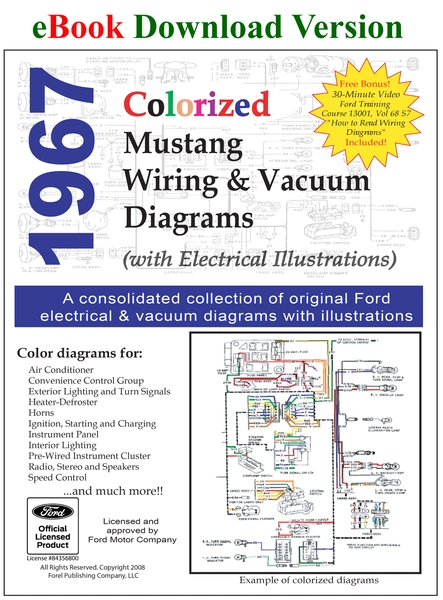
If you've ever wrestled with a rat's nest of wiring under the dash of a classic Mustang, you know that feeling of complete bewilderment. Which wire goes where? What's that mysterious connector supposed to plug into? For anyone restoring or maintaining a 1967 Mustang, the right documentation isn't just helpful—it's absolutely essential. That's where this colorized wiring and vacuum diagram guide comes into play, and it's got some fascinating quirks that every owner should understand before diving in.
The Ford Training Video: A Window Into 1960s Automotive Technology
One of the most valuable components of this guide is something you might not expect from a wiring diagram collection: a 30-minute Ford training video from the era teaching technicians how to actually read these diagrams. This isn't some modern interpretation—it's the real deal from when these cars rolled off the assembly line. The video covers fundamental concepts like series versus parallel circuits and how to trace wires through complex schematics, skills that Ford considered "increasingly important" even back in 1968 as vehicles grew more electrically sophisticated. If you think modern cars are complicated, imagine being a technician in the late '60s watching electrical systems evolve from simple point-to-point wiring to the more complex integrated systems appearing in models like the Mustang.
The Reality Check: Understanding What You're Actually Getting
Here's something critical that many buyers don't realize: the colors shown in these diagrams won't always match what you'll find in your actual vehicle. The publisher openly states that wire colors have been visually edited for clarity, which means you can't just match colors blindly. This is actually pretty common in technical documentation—making things readable sometimes means sacrificing perfect accuracy. Even more interesting, there were variations between different original Ford wiring diagrams from 1967, which means you might need to cross-reference multiple sources to nail down exactly what you're looking at.
The guide includes an extensive wire identification table with hundreds of entries, mostly sourced from Form 7760-67, with a few exceptions from FD-7795P-67. Some wire numbers have up to seven variants (labeled A through G), particularly for common colors like black, blue-red stripe, and black-green stripe wires. This reflects the reality of Ford's manufacturing process—different plants, different build dates, and different option packages all contributed to wiring variations.
What Systems Are Actually Covered?
The diagrams span everything from air conditioning (a luxury option in '67) to the charging system, ignition circuits, instrument clusters, and radio wiring. You'll find specific schematics for components like A/C controls, blower motors, seat belt warning relays (a relatively new safety feature at the time), and parking brake switches. The guide also covers Fairlane, Cougar, and Falcon models from the same era, which shared many electrical components with the Mustang.
The Fine Print Matters
It's worth noting that Forel Publishing includes comprehensive liability disclaimers stating this content is "general information only" and recommends consulting professional experts for actual repair work. This isn't unusual for aftermarket technical publications, but it's a reminder that these diagrams are compiled from various Ford sources and enhanced for clarity rather than being direct factory reproductions. They're incredibly useful tools, but they're meant to guide your work, not replace proper diagnostic procedures and common sense troubleshooting.
For anyone serious about keeping a '67 Mustang running correctly—or bringing one back from the dead—having accurate wiring information is non-negotiable. This guide offers that information in a more accessible format than the original black-and-white Ford publications, complete with that invaluable training video that'll teach you to think like a Ford technician from the golden age of American muscle cars.