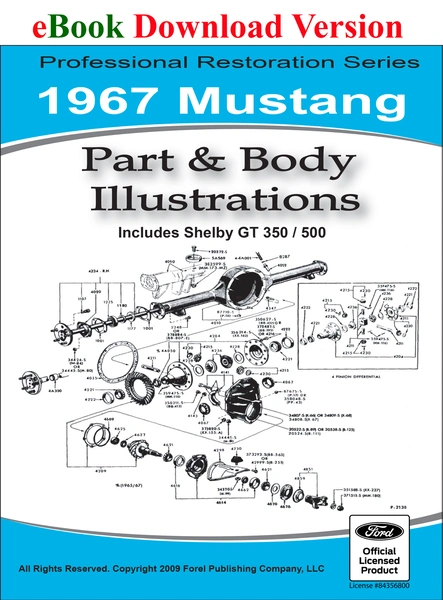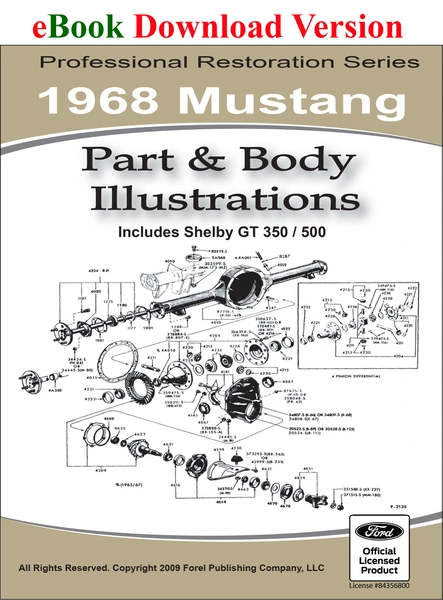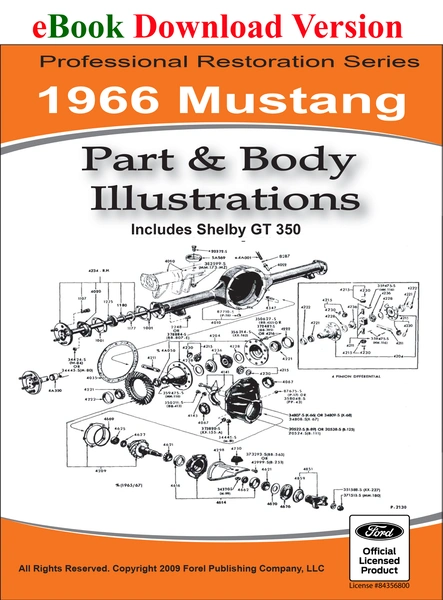
If you've ever stood in front of a partially disassembled 1966 Mustang wondering exactly how that dashboard trim piece attaches, or which specific bracket holds the exhaust system in place, you're not alone. The 1966 Mustang represented Ford's continuation of the pony car revolution, but maintaining these classics today requires navigating a maze of components that haven't been in production for over half a century. That's where this parts and body illustrations manual becomes absolutely invaluable.
Why This Manual Matters More Than You'd Think
Originally compiled from Ford's 1965/72 Master Parts and Accessory Catalog, this reproduction isn't just another generic parts book. It's your decoder ring for understanding how Ford engineers actually designed these vehicles to go together. The manual covers both standard Mustangs and the legendary Shelby GT 350 models, which is particularly important because Shelby modifications often involved specific parts that differ from base models. When you're trying to restore a GT 350 to authenticity, knowing which components are unique becomes critical.
What makes this manual genuinely useful is how it organizes information. Rather than forcing you to guess where a part might be located, it offers three different navigation methods. There's the traditional sectional groupings (Section 20 covers all brake components, for example), an alphabetical index that lists components multiple times if they appear in different diagrams, and a numerical index that follows Ford's original system. This redundancy isn't accidental—it's designed to help you find parts quickly, whether you know the proper Ford terminology or you're just describing "that bracket thing near the transmission."
What's Actually Inside
The coverage is remarkably comprehensive. You'll find detailed illustrations for both the 200 CID 6-cylinder and 289 CID V8 engines, which is essential because these powerplants don't share many components. The manual breaks down every major system: multiple transmission variants (Warner/Dagenham 4-speed, Ford 4-speed, C4 automatic, and 3-speed manual), complete brake assemblies, power steering components, and even the early emission control systems like the Thermactor air injection setup that Ford introduced during this era.
Body-specific variations are documented too. The manual distinguishes between hardtop and fastback configurations, noting where parts differ. Convertible owners will appreciate the dedicated sections for top mechanisms and related hardware—components that are notoriously difficult to source and reinstall correctly without proper reference materials. Interior trim pieces, seat assemblies, bumpers, and lighting systems all receive their own detailed diagrams.
Real-World Applications
Let's talk practical use. Say you're replacing the rear axle assembly. The manual shows both locking and non-locking types with various ring gear sizes, complete with part numbers and assembly codes. This isn't just academic information—it helps you verify you're ordering the correct replacement parts before spending money. The exploded diagrams reveal how components stack together, which fasteners go where, and the proper assembly sequence.
The transmission section demonstrates this value particularly well. The C4 automatic transmission diagrams break down clutches, valve bodies, and control mechanisms—components that professional transmission shops charge hundreds of dollars just to diagnose. Having visual references helps you understand what's failing and whether a repair is within your capability.
The Bottom Line for Mustang Owners
This manual won't teach you how to rebuild an engine or adjust valves, but that's not its purpose. It's a reference guide that answers the question every restoration project inevitably poses: "How does this actually go back together?" Whether you're doing a frame-off restoration or simply replacing worn components, having factory-accurate illustrations prevents costly mistakes and helps maintain authenticity. For anyone serious about keeping a '66 Mustang on the road, this manual eliminates guesswork from the equation.