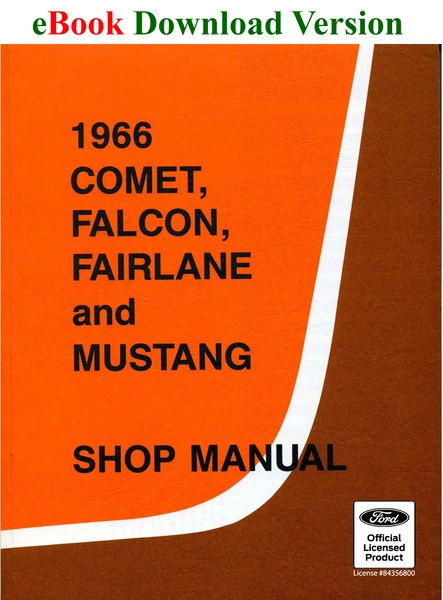
If you've ever cracked open the hood of a 1966 Mustang, Falcon, Fairlane, or Comet, you know these classics weren't built with computerized diagnostics or YouTube tutorials in mind. They're mechanical marvels from an era when carburetors ruled and understanding your vehicle meant getting your hands dirty. That's exactly why the official 1966 shop manual for these Ford models remains an invaluable resource today—it's the original blueprint for keeping these legends on the road.
Decoding Your Classic Ford's DNA
One of the manual's most practical features is something you'll use before you even pick up a wrench: understanding your vehicle's identification system. The warranty plate on your left front door's rear face isn't just a random collection of letters and numbers—it's a complete genetic profile of your Ford. Those codes reveal everything from your original paint color and interior trim to transmission type and axle ratio. Here's the thing most people don't realize: the official VIN for title and registration isn't actually on that warranty plate. It's stamped on the left front fender apron, and knowing where to find it can save you headaches when dealing with paperwork or verifying authenticity during a restoration.
The manual breaks down assembly plant codes spanning facilities from coast to coast, transmission identifiers for both manual and automatic variants, and rear axle specifications. For anyone restoring a numbers-matching classic or simply trying to order the correct replacement parts, this information is worth its weight in gold.
Real-World Brake System Knowledge
Let's talk about one of the most critical systems in any vehicle—the brakes. The manual dedicates substantial coverage to brake diagnostics and service, and it's easy to see why. These 1966 models came during a transitional period when disc brakes were just starting to appear on front wheels, while many still ran drum brakes all around. Understanding the differences isn't just academic—it affects everything from bleeding procedures to maintenance intervals.
The manual walks you through a brilliant diagnostic test for vacuum brake boosters: with your foot on the pedal, start the engine. If the pedal falls away under your foot, the booster's working properly. It's simple, but it tells you immediately whether you've got a vacuum issue without pulling anything apart. For bleeding hydraulic lines, the sequence matters: right rear, left rear, right front, left front—always starting with the longest lines first. With disc brakes, you'll need more pedal pumping and should check that master cylinder frequently because disc systems gulp fluid during bleeding.
There's also practical wisdom here that prevents costly mistakes. The manual emphasizes that brake shoes worn down to 0.195 inches or less need replacement, and rotor runout shouldn't exceed 0.0025 inch. After 30,000 miles or any signs of overheating—like blue coloring on brake shoes—wheel cylinders should be overhauled. These aren't arbitrary numbers; they're safety thresholds that still apply today.
Why This Manual Still Matters
What makes this shop manual special isn't just the comprehensive coverage of all 22 major vehicle systems—it's the factory-level detail that came straight from Ford's engineering specifications. This is the same resource dealership mechanics used when these cars rolled in for service in 1966. The procedures, torque specifications, clearances, and diagnostic steps reflect Ford's original intent for maintaining these vehicles.
Whether you're tackling a full restoration, performing routine maintenance, or diagnosing that mysterious rattle, this manual provides the authoritative guidance that generic repair books simply can't match. It's not just about fixing what's broken—it's about understanding how these classic Fords were designed to work, which helps you keep them running authentically and reliably for years to come.