If you've ever tackled a classic Ford restoration from the mid-1960s through early 1970s, you know the frustration of ordering the wrong part. Maybe the brake assembly doesn't quite match, or that trim piece is just slightly off for your specific model year. Here's the thing: Ford's part numbering system from this era wasn't just complicated—it was brilliantly systematic once you understood it. And that's exactly where the 1965-1972 Ford Car Master Parts and Accessory Catalog becomes absolutely indispensable.
Cracking Ford's Vintage Part Number Code
What makes this catalog special isn't just its comprehensiveness—it's that it teaches you to speak Ford's language. The part numbering system they used is actually quite clever. The first character tells you the decade (C for the 1960s, D for the 1970s), the second digit shows the specific year, and the third character identifies your model. So when you're looking at a Mustang part, you'll see that "Z" designation, while Falcon parts carry a "D" code and Thunderbird pieces use "S." Understanding this system means you won't accidentally order a 1968 part when you need a 1970 version—a mistake that's easier to make than you'd think.
The suffix letters are equally important. That "A" at the end? It's the first engineering revision. "B" means it's been changed twice. This matters because Ford constantly improved parts during production runs, and you'll want the latest revision for reliability, especially on critical components like brake systems or steering linkages.
Why You Need Both Volumes
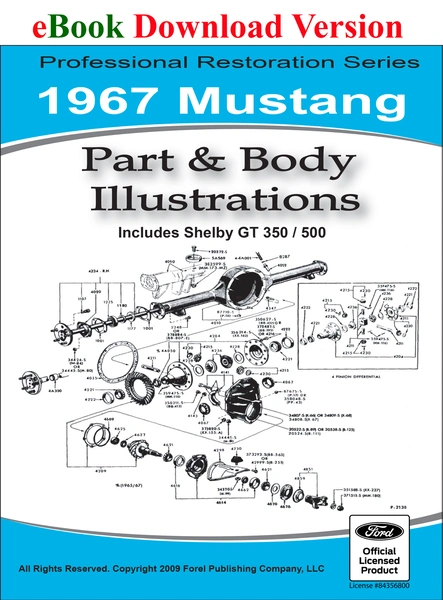
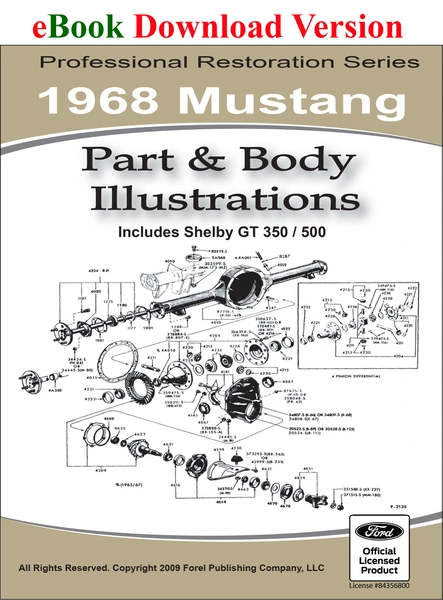
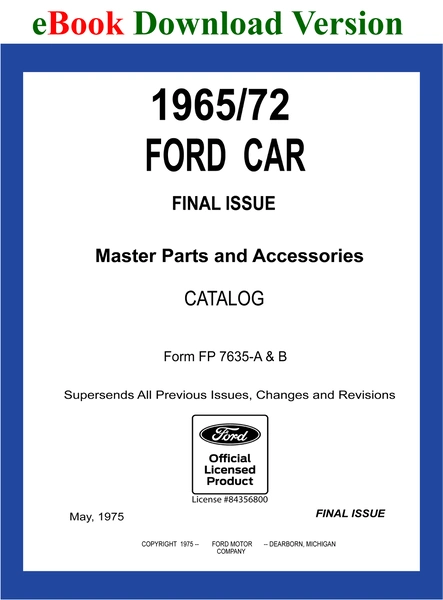
Here's something that trips up first-time users: this catalog comes in two volumes that work together like a matched set. The Text Catalog (FP-7635-A) gives you complete part numbers, while the Illustration Catalog (FP-7635-B) shows exploded diagrams. You can't effectively use one without the other. When you're staring at a disassembled dashboard wondering which bracket goes where, those exploded diagrams become worth their weight in gold.
The system divides everything into Chassis Group (your mechanical bits—engines, transmissions, brakes) and Body Group (doors, seats, interior trim). Each group is further broken down into numbered sections. What's brilliant is that the section number actually forms the leading digits of the group number, so navigation becomes intuitive once you've used it a few times.
The Engineering Number Trap
Here's a critical distinction that can save you serious headaches: engineering numbers stamped on parts during manufacturing aren't the same as service part numbers used for ordering. I can't count how many people have tried ordering parts using the casting number they found on their original component, only to get nowhere. The catalog clarifies this difference and shows you how to cross-reference properly.
Real-World Value for Restorers
What really sets this catalog apart is its original publication date—May 1975. This was issued while these vehicles were still relatively current, meaning the information comes directly from Ford's engineering documentation, not someone's best guess decades later. For anyone chasing authenticity in a restoration, that provenance matters enormously.
The identification numbers and cross-reference charts are particularly valuable when you're dealing with components like rear axles. The catalog doesn't just give you a part number—it provides specifications like axle ratios and spline counts, helping you verify compatibility before you commit to a purchase.
Whether you're rebuilding a Mustang's front suspension, hunting down correct body trim for a Galaxie 500, or just trying to maintain your classic Ford properly, this catalog provides the roadmap. It's the difference between guessing and knowing—and in restoration work, that difference can mean thousands of dollars and countless hours saved.