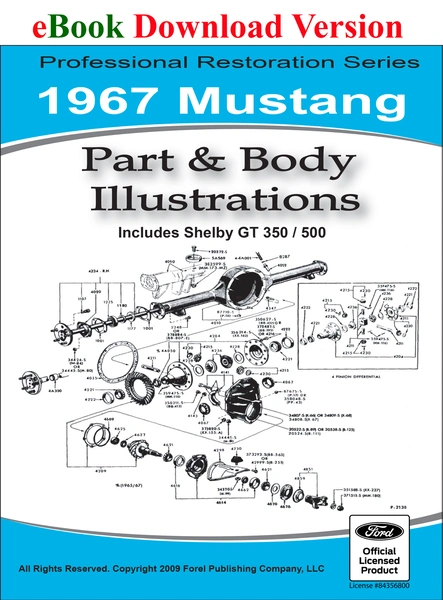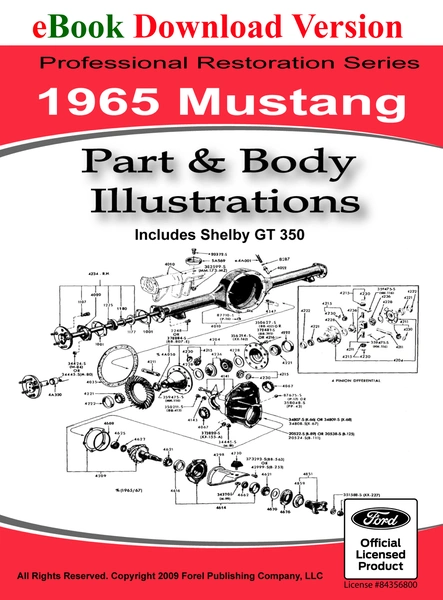
If you've ever tried restoring a classic Mustang without proper documentation, you know the frustration of staring at a pile of parts wondering where exactly that mystery bracket goes. The 1965 Mustang Part and Body Illustrations manual isn't just another catalog—it's a time machine that connects you directly to Ford's original engineering specifications from one of the most transformative years in automotive history.
Why 1965 Was a Pivotal Year for Mustang Documentation
The 1965 Mustang represented Ford's refinement of the original 1964½ launch, and this manual captures that critical transition period. What makes this publication particularly valuable is that it draws from Ford's 1965/72 Master Parts and Accessory Catalogs, giving you a broader window of parts compatibility than you'd expect. This matters because many components evolved gradually, and understanding which parts interchange between early and later models can save you countless hours of trial and error.
The manual covers everything from the economical 200 cubic inch six-cylinder all the way through massive V8s up to 460 cubic inches—engines that weren't even available in 1965 Mustangs. This extended coverage actually helps you understand the Mustang's mechanical DNA and how Ford's engineering decisions evolved across the entire first-generation platform.
Three Ways to Find What You're Looking For
Here's where this manual shines compared to hunting through online forums: it's organized three different ways simultaneously. You can search by Ford's original section numbers (Section 20 for brakes, for example), by illustration number if you've got a reference from another source, or alphabetically by component name. This triple-index system means you're never more than a few seconds away from finding that specific brake cylinder assembly or transmission diagram you need.
The numerical organization (diagrams ranging from 3192 through EA-45) might seem odd at first, but it follows Ford's internal cataloging system. Once you understand it, you'll appreciate how it groups related components together in ways that alphabetical listings simply can't match.
Real-World Applications Beyond Basic Restoration
What separates this from a simple parts list is the exploded diagram format. When you're trying to figure out why your three-speed manual transmission (the 2.77 type used in '65-'67 models) is grinding, seeing the actual relationship between components helps you diagnose the problem. The same goes for understanding why your convertible's sheet metal doesn't quite align—the diagrams show you how fastback, hardtop, and convertible body structures differ fundamentally.
The Shelby GT 350 coverage deserves special mention. These high-performance variants had unique components that are notoriously difficult to identify correctly. Having factory-authorized diagrams for these parts can mean the difference between an authentic restoration and one that's just "close enough."
Understanding the Limitations and Using It Wisely
The publisher includes accuracy disclaimers for good reason—this is a reproduction, and some part numbers have changed over the decades as Ford revised specifications. It's best used as a visual reference and starting point rather than gospel truth. When you're ordering expensive components, cross-reference these diagrams with current supplier catalogs and consult with specialists who know which parts have been superseded.
That said, for understanding how systems fit together, identifying mystery parts at swap meets, or planning your restoration approach, these illustrations are invaluable. They're the next best thing to having a Ford engineer from 1965 standing in your garage explaining how everything works.
Whether you're tracking down the correct voltage regulator for your alternator-equipped Mustang or trying to understand the difference between locking and non-locking rear differentials, this manual provides the visual clarity that makes complex mechanical systems finally make sense.