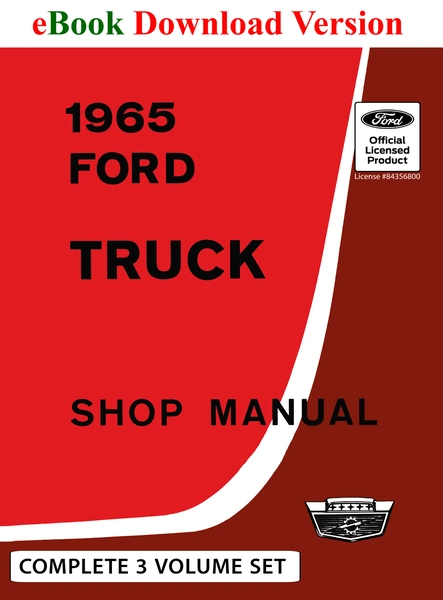
When Ford's trucks rolled off the assembly line in 1965, they represented a fascinating transitional period in American automotive history. These weren't the computer-controlled vehicles we know today—they were mechanical machines through and through, built during an era when understanding your truck's systems was both possible and necessary. The 1965 Ford Truck Shop Manual captures this mechanical simplicity while revealing just how sophisticated these workhorses actually were.
The Detective Work of Vehicle Identification
Before you can fix anything on a '65 Ford truck, you've got to know exactly what you're working with—and that's not always as straightforward as it sounds. The manual dedicates substantial space to decoding the truck's identity, and there's a good reason for that. Your truck's Rating Plate holds the key to understanding which of the many engine options, axle ratios, and transmission configurations you're dealing with. Located on the left front door of conventional cabs or tucked in the glove compartment of cowl units, this plate isn't just bureaucratic paperwork—it's your roadmap to ordering correct parts and understanding your truck's capabilities.
What's particularly interesting is the sheer variety Ford offered. Engine options ranged from a modest 170 cubic inch four-cylinder all the way up to massive Cummins diesel options displacing 855 cubic inches. Your truck could've left the factory with a gross vehicle weight rating anywhere from 4,200 pounds for a light-duty F-100 to a staggering 53,000 pounds for heavy-duty commercial haulers. That's not just variety—that's an entirely different vehicle philosophy under the same Ford badge.
When Brakes Go Bad: Real-World Diagnostics
The manual's brake troubleshooting section reveals why these trucks have earned such loyal followings—they're actually diagnosable without a computer. Take the classic "spongy pedal" complaint. The manual walks you through a logical progression: check fluid levels first, then hunt for leaks, then bleed the system for air. It's methodical, it's sensible, and it works.
One particularly useful diagnostic trick involves the brake pedal travel test. Your pedal shouldn't go more than halfway to the floor under normal braking. If it does, you're looking at one of three culprits: low fluid, system leaks, or air in the lines. The manual even specifies a 20 mph road test for checking even braking—simple, but effective for catching problems like misaligned shoes or contaminated linings before they become dangerous.
For trucks equipped with vacuum brake boosters (a relatively sophisticated feature for the era), the manual outlines specific vacuum tests. Your check valve should hold 18-21 inches of vacuum and shouldn't drop more than an inch in 15 seconds. These aren't arbitrary numbers—they're the difference between confident stops and white-knuckle moments.
Why This Manual Still Matters
Here's what makes this shop manual genuinely valuable: it was written for professional mechanics who needed to fix these trucks quickly and correctly. There's no dumbing down, no vague instructions. You'll find transmission codes for everything from three-speed manuals to five-speed auxiliary units from Spicer, Warner, Clark, and Fuller. You'll discover axle ratio specifications for Timken units with capacity ratings spelled out in thousands of pounds.
Whether you're keeping a vintage F-250 work truck running, restoring a C-Series tilt cab, or maintaining a P-Series parcel delivery vehicle, this manual speaks the language of Ford's engineering from that era. It's not just about nostalgia—it's about having the actual factory information that makes the difference between guessing and knowing. And in the world of mechanical troubleshooting, that difference is everything.