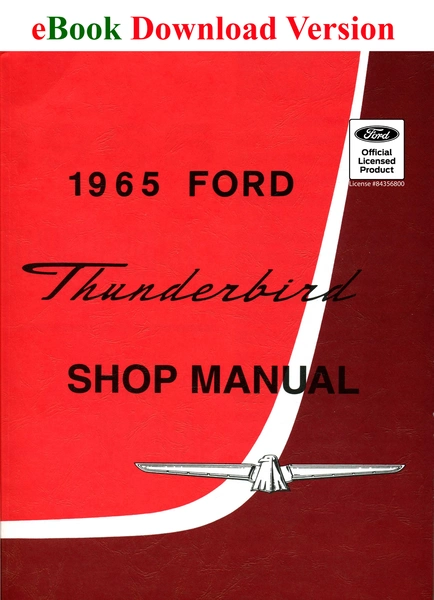
When Ford rolled out the fourth-generation Thunderbird in 1964, they weren't just building cars—they were crafting rolling statements of American luxury. The '65 model continued this tradition with its distinctive sequential taillights and powerful V8 options. But here's something most collectors and restorers discover the hard way: keeping these magnificent machines running requires specialized knowledge that's become harder to find with each passing decade. That's where the 1965 Ford Thunderbird Shop Manual becomes absolutely essential.
Why This Manual Matters More Than You'd Think
This isn't your typical owner's handbook with basic maintenance schedules. Originally published by Ford Motor Company in September 1964, this was the actual service documentation that dealership mechanics used when these T-birds were brand new. The difference? It contains the kind of precise technical specifications and diagnostic procedures that can save you thousands of dollars in guesswork and misdiagnosis.
Take the disc brake system, for example. The '65 Thunderbird featured a sophisticated fixed caliper design with four opposed pistons and a ventilated rotor—cutting-edge technology for its time. The manual doesn't just tell you how to replace brake pads; it explains the entire self-adjusting mechanism, including those critical piston seals that serve triple duty: hydraulic sealing, automatic piston return, and self-adjustment. Without understanding how these systems work together, you're essentially working blind.
Decoding Your Thunderbird's Identity
Here's something that confuses many owners: your T-bird actually has two different identification numbers. There's the Vehicle Identification Number (VIN) stamped on the hood support—that's what you'll use for title and registration. Then there's the Vehicle Warranty Number on the warranty plate, which isn't for legal purposes but contains a treasure trove of information about your car's original configuration. The manual breaks down body style codes (63D, 63A, 76A, 63B), assembly plant locations, original paint colors, interior trim specifications, and manufacturing dates. For anyone restoring a Thunderbird to factory-correct specifications, this information is pure gold.
Real-World Problem Solving
What really sets this manual apart is its diagnostic approach. Let's say you're experiencing brake problems—maybe a hard pedal or unexpected grabbing. The manual provides comprehensive troubleshooting matrices that cross-reference symptoms with potential causes. It'll walk you through checking for vacuum leaks in the booster system, inspecting check valves, and examining diaphragm assemblies. But it doesn't stop there—it includes specific procedures like adjusting the master cylinder push rod to precisely 0.990-0.995 inches, verified with a micrometer depth gauge.
There's even clever diagnostic tricks, like the air pressure test for checking if the piston cup properly clears the compensating port. Apply light air pressure with brake fluid present, and bubbles tell you everything's adjusted correctly. These are the kind of insider techniques that separate successful restorations from expensive mistakes.
The Devil's in the Details
Small details make huge differences in these cars. The manual emphasizes that you should never refinish rotors exceeding runout specifications, and wheel bearings must be adjusted after checking—ignore this, and you're risking brake failure. It warns that caliper halves must never be separated and should always be replaced as complete units. For rear brakes, there's specific guidance about replacing shoes when lining is worn within 1/32 inch of rivet heads, and what signs of overheating look like (blue coloring on shoes, stretched springs).
The proportioning valve system that regulates hydraulic pressure between front and rear brakes? That's explained in detail, showing you why it prevents premature rear wheel skid during heavy braking—knowledge that's crucial when you're troubleshooting stopping issues.
An Investment in Preservation
Whether you're maintaining a survivor, restoring a project car, or just trying to keep your classic T-bird roadworthy, this manual represents decades of engineering knowledge captured at the source. It's the difference between guessing your way through repairs and actually understanding these magnificent machines the way Ford's own engineers intended. For anyone serious about Thunderbird ownership, it's simply indispensable.