If you've ever found yourself elbow-deep in the engine bay of a 1965 Mustang, Falcon, Comet, or Fairlane, you know that working on these classics isn't quite like turning a wrench on modern vehicles. These cars were built during a transitional era for Ford—a time when the company was churning out some of its most legendary models while still relying on straightforward mechanical systems that today's enthusiasts can actually understand and fix themselves.
Why This Manual Matters Six Decades Later
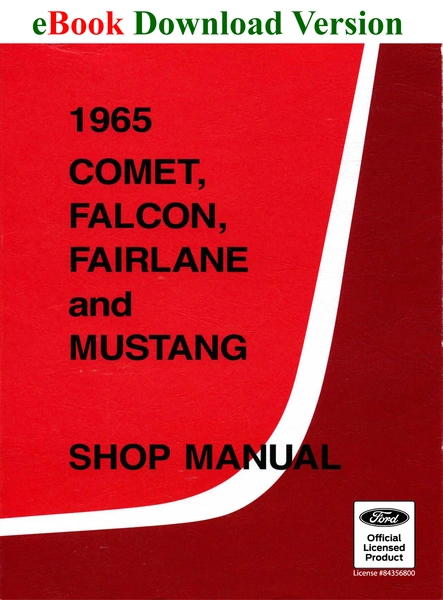
The 1965 Ford shop manual represents something special in automotive history. This was the year the Mustang was establishing itself as an American icon, the Falcon was proving that compact cars could be reliable workhorses, and the Fairlane was bridging the gap between economy and performance. What makes this particular manual invaluable is that it captures the exact procedures Ford's own dealership technicians used—not some aftermarket interpretation or modern reimagining.
Here's what's fascinating: when you crack open this manual, you're not just getting repair instructions. You're getting a window into how Ford thought about these vehicles. The warranty plate decoding system alone tells a story—every number and letter stamped on that plate mounted to the left front door reveals the car's DNA. Assembly plant, paint color, interior trim, transmission type, even the specific date it rolled off the line. It's like a birth certificate for your classic Ford.
The Brake System: Where Rubber Meets Reality
One of the manual's strongest sections covers brake service, and there's good reason for that. By 1965, Ford was dealing with an interesting mix of old and new technology. Some Mustangs came with the new-fangled disc brakes (at least up front), while many Falcons and Comets still relied entirely on drums. The manual doesn't skip over the complexity here—it digs into specific troubleshooting matrices that connect symptoms to causes.
For example, if you're experiencing brake chatter or pull, the manual walks you through a systematic diagnosis covering everything from seized pistons to contaminated linings. The specifications are refreshingly precise: brake shoe linings should be replaced when worn to 0.030 inches, rotor runout can't exceed 0.002 inches, and that critical lining-to-rotor clearance needs to stay between 0.002 and 0.010 inches. These aren't suggestions—they're the exact tolerances Ford engineers determined would keep these cars stopping safely.
More Than Just Fixing What's Broken
What sets this manual apart from generic repair guides is its preventive focus. The bleeding procedures for hydraulic brake systems, for instance, aren't just about fixing spongy pedals—they're about understanding how the system works. Whether you're using the manual method or pressure bleeding with 10-30 psi, you're learning the engineering logic behind these cars.
The VIN and body code charts might seem mundane at first glance, but they're actually treasure maps for authenticity. When you're restoring a '65 Comet or trying to verify whether that Mustang convertible really has its original engine, these codes tell the truth. The manual includes complete breakdowns for every body style—sedans, hardtops, convertibles, wagons—even distinguishing between bench and bucket seat configurations.
A Technician in Your Back Pocket
Working on a classic Ford without the factory manual is like trying to assemble furniture without instructions—sure, you might get it together eventually, but you'll probably have some leftover bolts and a nagging suspicion you've done something wrong. This manual eliminates that guesswork. It's the difference between hoping you've got it right and knowing you've followed the same procedure a Ford mechanic would've used in 1965.
Whether you're tackling your first brake job or you're a seasoned restorer chasing authenticity, this manual speaks the language these cars were designed in. And that's worth its weight in vintage Ford parts.