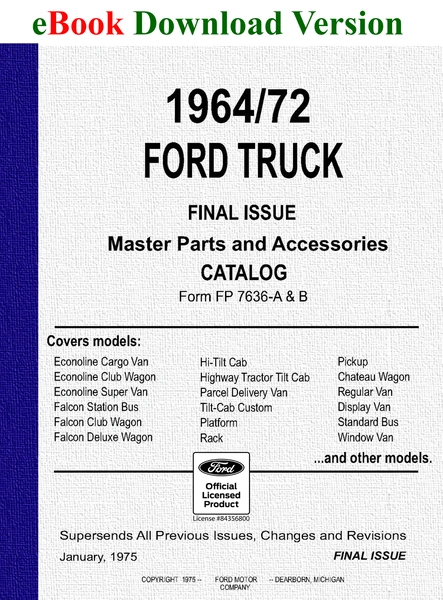
If you've ever tried hunting down the correct replacement part for a vintage Ford truck from the 1960s or early '70s, you know the frustration of dealing with incomplete information, aftermarket catalogs that don't quite match up, or eBay listings with vague descriptions. That's exactly why the 1964-1972 Ford Truck Master Parts Catalog, published in its final form in January 1975, remains an invaluable resource for anyone serious about maintaining or restoring these classic workhorses.
What Makes This Catalog So Essential?
This isn't just another parts list—it's the definitive factory reference that Ford dealership mechanics used to identify and order every single component for trucks built during this era. What sets it apart is the ingenious indexing system Ford developed. You can locate parts using four different methods: by part name, through illustrations, by identification number, or using your truck's specific specification list information. This flexibility was crucial back when a mechanic might be working on everything from an Econoline van to a heavy-duty F-series pickup in the same afternoon.
The catalog covers an impressive range of models, including not just the popular F-series trucks but also Econoline vans, Falcon-based wagons, various cab configurations, and commercial delivery vehicles. For U.S. vehicles, coverage spans 1964-1972, while Canadian models are documented from 1965-1972—an important distinction that's often overlooked when sourcing parts.
Understanding the Numbering System
One of the most brilliant aspects of this catalog is Ford's systematic approach to parts organization. Components are grouped into numerical series that make logical sense once you understand the pattern. For example, the 1000-1099 series covers basic chassis components, while specific ranges like 10000-10399 handle generators and alternators, and 12000-12427 cover ignition components including coils, distributors, and spark plugs.
The system even accounts for body type variations using specific codes—81 for closed cabs, 91 for tilt cabs—ensuring you're getting the right part for your specific truck configuration. This is particularly helpful when dealing with left-hand and right-hand components, which the catalog differentiates through separate line items, adjacent columns, or implied quantities.
Beyond Ford: Diesel Engine Coverage
Here's something many enthusiasts don't realize: this catalog doesn't just cover Ford-built components. It includes comprehensive parts information for diesel engines from Caterpillar, Cummins, and Detroit Diesel that were factory options in certain Ford truck models. This cross-manufacturer documentation is incredibly valuable, as these engines required specialized parts that can be challenging to identify correctly decades later.
Practical Applications for Modern Restoration
What really makes this catalog indispensable is how it solves real-world restoration challenges. Let's say you're restoring a 1968 F-250 and you need to replace the door trim. The catalog's body parts section (with ranges like 288A00-289A99 for quarter window molding) gives you the exact Ford part number, eliminating guesswork about whether an aftermarket piece will fit correctly.
The catalog also uses a diagonal line notation system for model year applications that's incredibly useful. When you see "64/" it means 1964-onward, "64/69" indicates 1964-1969 only, and "67" means that specific year alone. This precision helps you avoid ordering parts that look similar but won't actually work on your particular model year.
A Time Capsule of Automotive Engineering
Beyond its practical utility, this catalog represents a fascinating snapshot of automotive engineering from Ford's golden era of truck manufacturing. The comprehensive coverage—from floor mats and scuff plates through complete transmission assemblies—reflects the modular approach to vehicle design that made these trucks so versatile and long-lasting. It's no wonder so many of these trucks are still on the road today, and why this catalog, republished by Forel Publishing Company in 2007 under license from Ford, continues to be an essential tool for anyone committed to keeping these classics running authentically.