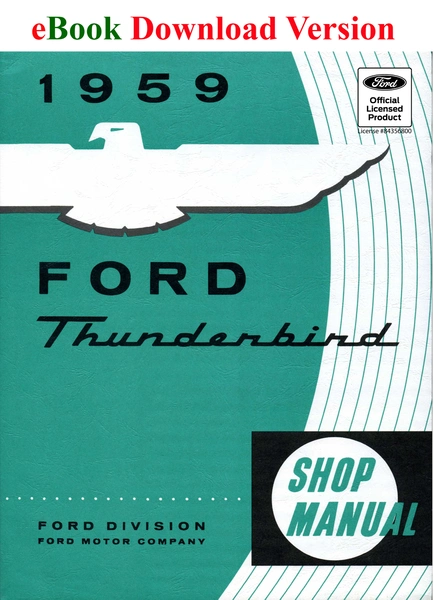
The 1959 Ford Thunderbird represents a pivotal moment in American automotive history—it's the year the T-Bird shed its two-seat sports car roots and emerged as a luxurious four-passenger "personal car." Behind the glamorous styling and chrome, though, these machines required meticulous care to keep running smoothly. That's where the original 1959 Ford Thunderbird Shop Manual becomes absolutely essential for anyone serious about maintaining or restoring one of these iconic vehicles.
Why This Manual Still Matters Today
What makes this shop manual particularly valuable isn't just that it's authentic Ford documentation—it's the systematic, logical approach to diagnosis that professional mechanics used during an era when troubleshooting meant hands-on detective work, not plugging in a computer. The manual emphasizes checking problems "in order of probable occurrence," which saves countless hours of frustration. For instance, before you tear into complex engine work, it walks you through simpler causes first: tune-up needs, wear patterns, then sudden failures.
This methodical approach is pure gold when you're dealing with common T-Bird headaches. If your engine cranks but won't start, the manual directs you through fuel delivery checks—testing the choke plate operation, accelerating pump function, and carburetor fuel inlet—before moving to ignition system components. It's this kind of structured thinking that prevents you from replacing parts unnecessarily.
The Hidden Complexity of "Simple" Problems
Here's something many enthusiasts don't realize: those hydraulic valve lifters in your T-Bird's engine are incredibly sensitive. The manual reveals that the most common culprits for lifter malfunction aren't worn parts—they're dirt, gum, varnish, carbon deposits, and air bubbles in the oil. The diagnostic procedure is fascinating: you listen for metallic noise at each valve stem using a hose as a stethoscope, checking oil condition for air presence. This insider knowledge can save you from unnecessary lifter replacement when cleaning would've solved the problem.
The manual also covers procedures you won't find in generic repair guides, like checking valve clearance on the 352 and 430 engines by collapsing hydraulic lifters with specific gauges. If clearances are off, you'll need push rods that are 0.060" shorter or longer—and here's the critical part the manual emphasizes: after push rod replacement, you can't rotate the engine until the hydraulic lifters leak down to operating position. Miss that step, and you'll risk serious valve train damage.
Diagnostic Tools That Work Without Electronics
One of the most practical sections covers compression testing and manifold vacuum gauge readings. The manual specifies that compression readings should be uniform within 10 pounds between cylinders, and there's a clever diagnostic trick: if you add oil to a low-compression cylinder and the reading jumps 10+ pounds, you've got ring problems; if it stays the same, the valves are leaking. Simple, effective, and still relevant today.
The vacuum gauge diagnostics are equally revealing. Normal readings should be 19-20 inches for the 352 engine or 17-18 inches for the 430 engine. Abnormal patterns indicate specific issues—from gasket leaks to exhaust back pressure—giving you a roadmap before you start disassembly.
Beyond Quick Fixes: Real Maintenance Wisdom
The manual's maintenance schedule reflects an era when regular service actually meant something: minor tune-ups every 6,000 miles, major tune-ups at 12,000 miles. These weren't just oil changes—they included spark plug maintenance, compression testing, intake manifold checks, and comprehensive electrical system inspection. Following this schedule is what kept these cars running reliably for decades, and it's still the best approach for preservation today.
Whether you're restoring a Squarebird to concours condition or keeping a driver on the road, this manual provides the factory-authentic procedures that maintain these magnificent machines the way Ford intended. It's not just a repair guide—it's a masterclass in vintage automotive diagnosis from the golden age of American cars.