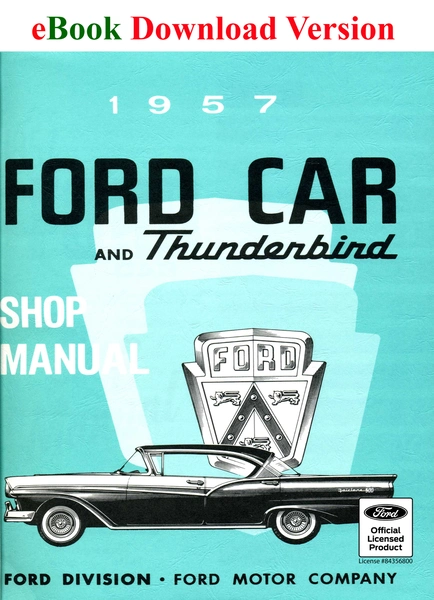
If you've ever tried to diagnose a rough idle on a 1957 Ford or wondered why your Thunderbird just won't accelerate like it should, you'll understand why mechanics guard their original shop manuals like treasure maps. The 1957 Ford Car and Thunderbird Shop Manual isn't just another old book—it's the actual diagnostic playbook that Ford dealership technicians relied on during the height of the finned-chrome era.
Why This Manual Still Matters Seven Decades Later
Here's something that surprises most classic car owners: the systematic troubleshooting approach in this manual is arguably more valuable than finding original parts. While you can hunt down reproduction components, the diagnostic logic that Ford's engineers built into this manual can't be replicated by modern generic repair guides. These vehicles were engineered differently, and understanding that engineering matters tremendously when things go wrong.
Take engine misfiring, for example. The manual doesn't just tell you to "check the ignition system." It teaches you to differentiate between misfiring at idle versus high speed, then systematically walks you through fuel system problems, ignition timing issues, valve lash adjustments, and even exhaust restrictions—because each symptom pattern points to different root causes. That's the kind of specific, era-appropriate knowledge you simply can't get from watching YouTube videos about modern fuel-injected engines.
The Compression Test That Reveals Everything
One procedure that's particularly brilliant is the compression testing protocol. The manual specifies warming the engine first, then cranking with wide-open throttle and choke while testing each cylinder with consistent strokes. But here's the clever part: it tells you that compression readings should be uniform within 10 pounds across all cylinders, and if you've got a low reading, adding oil can temporarily seal ring leakage—immediately telling you whether you're dealing with worn rings or valve problems. That's diagnostic efficiency that saves hours of guesswork.
The manifold vacuum gauge diagnostics are equally revealing. A steady low reading means general power loss across the board. A fluctuating needle? That's pointing you toward individual cylinder issues or ignition defects. A gradual drop indicates exhaust restrictions. It's like the engine is speaking to you through that gauge, if you know the language.
The Details That Make or Break a Restoration
What really sets this manual apart are the specific tolerances and specifications that you won't find anywhere else. Did you know that push rods with runout exceeding 0.020 inch can't be straightened and must be discarded? Or that cylinder head flatness can't exceed 0.006 inch overall? These aren't suggestions—they're the engineering limits that determine whether your rebuilt engine will seal properly and run right.
The valve spring specifications are equally critical. Springs must maintain 71-79 lbs of pressure at 1.780 inches, with a wear limit of 64 lbs. You can't just throw in "close enough" replacement springs and expect proper performance. The manual even specifies that valve spring assembled height should be 1-13/16 to 1-27/32 inches, and warns against using spacers unnecessarily because they'll overstress the springs.
More Than Just Engine Work
While the engine sections are comprehensive, the manual covers everything from the thermostatic exhaust gas control valve (which should close when cold and open with light finger pressure at operating temperature) to proper valve seat grinding after reaming guides for oversize valves. It's the complete picture of how these vehicles were designed to function.
For anyone who owns or works on a 1957 Ford passenger car or Thunderbird, this manual isn't optional reading—it's essential reference material. It's the difference between guessing what might be wrong and knowing exactly where to look, what to measure, and what those measurements mean. That's knowledge worth having.