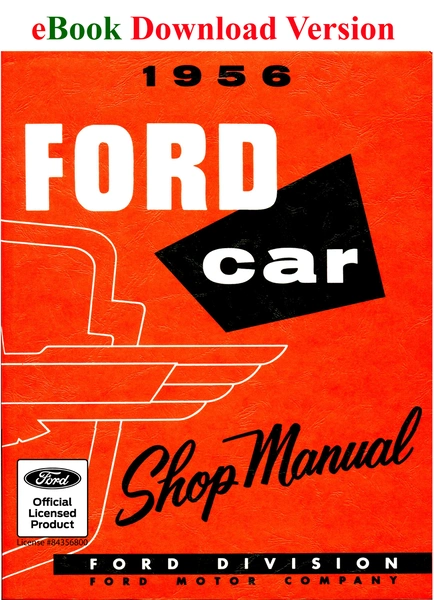
If you've ever tried to troubleshoot a classic Ford that won't start, you know that sinking feeling when you're not sure whether you're dealing with an ignition problem, fuel delivery issue, or something else entirely. The 1956 Ford Car Shop Manual doesn't just tell you what might be wrong—it walks you through a systematic diagnostic approach that's surprisingly relevant even today.
The Lost Art of Sequential Diagnosis
What's really striking about this manual is how it teaches you to think like a mechanic from the 1950s, when diagnostic computers didn't exist and troubleshooting was a methodical art. Take the starting problems section, for example. Instead of throwing parts at the problem, the manual guides you through a logical sequence: battery, battery cables, starter relay circuit, then finally the starter itself. It's the kind of ordered thinking that can save you hours of frustration and hundreds of dollars in unnecessary parts.
The spark test procedure is particularly brilliant in its simplicity. Hold an ignition wire 3/16 inch from the engine block and crank the engine. No spark or weak spark? You've got an ignition problem. Good strong spark but the engine won't fire? Time to look at fuel delivery. This single test essentially cuts your diagnostic time in half by telling you which entire system to focus on.
Why Mid-'50s Fords Have Unique Maintenance Needs
The 1956 model year represented a transitional period for Ford. You're dealing with engines that still used distributors with breaker points, generators instead of alternators, and carburetors that could be finicky about fuel quality. The manual's emphasis on dirt and foreign material as major sources of fuel system problems wasn't just cautionary—it reflected the reality of 1950s gasoline quality and the tight tolerances in Ford's updated carburetor designs.
One particularly useful section covers the compression test procedure, which includes a clever diagnostic trick: if compression is low, add oil to the cylinder and retest. If compression comes up, you've got worn piston rings. If it stays low, you're looking at valve problems. This simple test can tell you whether you need a ring job or valve work without tearing down the engine.
The Thunderbird Factor
What makes this manual especially valuable is its coverage of both standard Ford passenger cars and the iconic two-seater Thunderbird. The T-Bird had some unique components and tighter engine compartment tolerances, which is why the manual specifically notes that engines must be removed without the transmission due to space constraints—a critical detail if you're planning major service work.
Real-World Applications for Today's Enthusiast
Even if you're working on a '56 Ford in 2024, this manual's tune-up procedures remain the foundation of good maintenance. The compression testing, spark plug service, distributor inspection, and ignition timing procedures are exactly what these engines need. The manual's specification for fuel pump pressure (3.5 to 5.5 psi) and capacity (one pint in 30 seconds at 500 rpm) gives you concrete numbers to diagnose a weak fuel pump rather than just guessing.
The manifold vacuum testing section is another gem. The manual explains how to use a vacuum gauge to diagnose internal engine problems—worn rings, valve issues, or intake leaks—without disassembly. It's diagnostic wisdom that's been somewhat lost in the modern era of electronic scanning tools.
More Than Just Procedures
What sets this manual apart isn't just the step-by-step instructions—it's the underlying philosophy of proper diagnosis before repair. The troubleshooting sections consistently emphasize checking the simple, likely causes first before moving to more complex repairs. For overheating issues, you start with coolant leaks and belt tension before tearing into thermostats or water pumps. That logical progression can save you from unnecessary work and expense.
Whether you're keeping a Fairlane on the road, restoring a Crown Victoria, or maintaining a prized Thunderbird, this manual represents the accumulated knowledge of Ford's engineering department from the mid-1950s. It's not just a repair guide—it's a window into how these cars were designed to be serviced and maintained, straight from the source that created them.