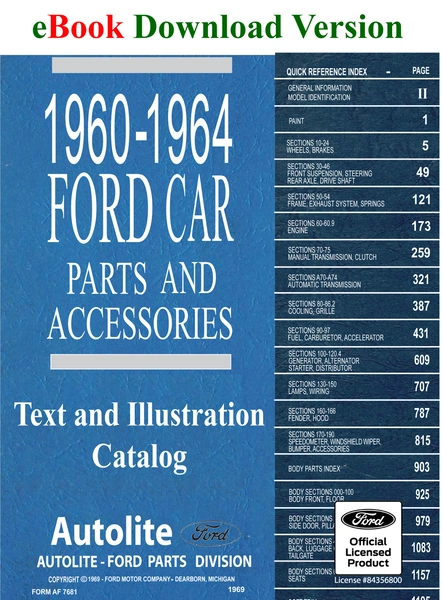
If you've ever tried tracking down the right part for a classic Ford from the 1960s, you know the frustration of dealing with incomplete information or modern catalogs that barely acknowledge these vintage beauties exist. That's what makes the original Ford Motor Company parts catalog covering 1960-64 models so invaluable—it's not just a parts list, it's a window into how Ford organized and documented every single component across their entire lineup during what many consider the company's most innovative period.
The Era That Changed Everything
The early 1960s were a pivotal time for Ford. You had the full-sized Fords competing with Chevy's Impala, the newly-introduced Fairlane creating the mid-size segment, the compact Falcon that saved the company's finances, and the Thunderbird transforming into a luxury sports cruiser. Each model had completely different engineering underneath, yet Ford developed a cataloging system sophisticated enough to track parts across all of them. This wasn't simple—we're talking about vehicles that shared almost nothing mechanically, from the Falcon's economical 144 cubic inch six-cylinder to the Thunderbird's massive 390 V8.
Decoding Ford's Numbering System
What's fascinating about this catalog is the dual-numbering system Ford employed. You'll find standard Ford part numbers alongside Autolite Sales Part Numbers in parentheses, which reflects the reality of 1960s automotive supply chains. Autolite was Ford's primary electrical and ignition supplier, and having both numbers meant you could source parts from either Ford dealerships or independent Autolite distributors—a practical consideration when parts availability could make or break a repair.
The model year notation system is equally clever. When you see "60/" next to a part, it means that component was used from 1960 forward through all subsequent years in the catalog. A notation like "61/63" tells you that part only fits 1961 through 1963 models—crucial information when you're dealing with Ford's rapid year-to-year changes during this period. They weren't just making cosmetic updates; suspension geometry changed, engine mounts were redesigned, and body structures evolved constantly.
Why Soft Trim Gets Its Own Section
The catalog's treatment of soft trim parts—seats, carpets, headliners, and interior panels—reveals just how complex color and trim combinations became. Ford offered dozens of interior color schemes, and each had specific trim codes. You couldn't just order "a front seat cover for a '62 Fairlane"—you needed to know whether you had trim code 56, 57, or any of the other variations. This catalog provides three different lookup methods: by color name, by trim code, or through miscellaneous listings. That level of organization was essential because Ford's interior options exploded during this era as buyers demanded more personalization.
The Practical Reality of Restoration
What makes this catalog genuinely essential today isn't just the part numbers—many of which are long obsolete—but the organizational logic it reveals. Understanding how Ford categorized components helps you figure out interchange possibilities. When you know that certain front suspension parts (Section 30) were shared across models, or that steering components (Section 35) might work across multiple years, you can expand your sourcing options dramatically. The catalog shows you which parts were truly model-specific and which were shared across Ford's lineup.
The companion illustrations catalog (Form AF-7682) that this references is equally important because these cars weren't modular in the way modern vehicles are. You often need to see the exploded diagram to understand how components relate spatially, especially for complex assemblies like instrument clusters or door mechanisms where multiple parts must work in precise coordination.
For anyone serious about maintaining or restoring early '60s Fords, this catalog represents institutional knowledge from the people who actually designed and built these cars. It's the difference between guessing and knowing—and when you're investing time and money in a classic Ford, that difference matters considerably.