If you've ever tried to restore or maintain a classic Ford from the late 1950s, you know the frustration of hunting down the right parts. You're staring at a component, wondering if it's original, what part number you need, or whether that piece even belongs to your specific model year. That's exactly why Ford's 1960-64 Parts and Accessories Catalog remains an indispensable tool over six decades later—it's the Rosetta Stone for decoding what actually goes where on these magnificent machines.
More Than Just a Parts List
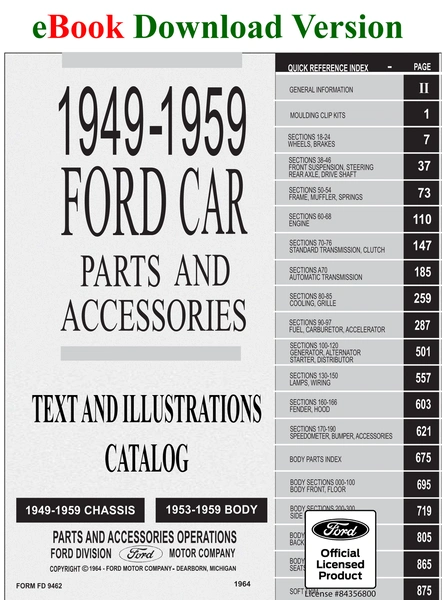
What makes this catalog particularly brilliant is how it spans a critical period in Ford history. While the cover says 1960-64, the real treasure is what's inside: comprehensive chassis parts coverage from 1949-1959, body parts from 1953-1959, and soft trim components from 1956-1959. This wasn't just another catalog—it was Ford's master reference guide during an era when dealers needed to service everything from post-war shoebox Fords to the revolutionary 1957 Fairlane 500s that redefined American automotive styling.
Cracking Ford's Numbering Code
Here's where things get interesting. Ford didn't just slap random numbers on parts. They created an intricate numbering system that's actually logical once you understand it. The first two digits of body part numbers tell you the body type: 70 for Tudor Sedans, 73 for Fordor Sedans, and so on. The remaining five digits identify specific component groups. It's like learning a new language, but once you've got it, you can navigate thousands of parts with confidence.
The catalog also teaches you to read your vehicle's patent plate—that small metal tag on your left front body pillar that most people ignore. It's packed with crucial information: assembly plant codes, body type, engine rating, paint color codes, trim scheme numbers, production date, transmission type, and axle ratio. When you're ordering unlisted parts or trying to maintain period-correct authenticity, this plate becomes your best friend.
Why This System Still Matters Today
Modern Ford enthusiasts might wonder why they should care about a 1960s-era catalog system. The answer's simple: authenticity and accuracy. When you're restoring a 1957 Thunderbird or keeping a 1959 Galaxie on the road, you can't just order "a door handle" and hope it fits. You need to know if you've got a Tudor or Fordor, what your trim scheme code is, and whether that part changed mid-year (which happened more often than you'd think).
The catalog works in tandem with an illustration guide (Form FD-9463), meaning you can either search by part name through the Quick Reference Index or visually identify components through illustrations. This dual approach was revolutionary for its time and remains incredibly practical. If you've ever tried describing a mystery bracket to a parts supplier over the phone, you'll appreciate having both visual and textual references.
Understanding the Functional Groups
Ford organized everything into logical numerical ranges: brakes are in the 2060 group, rear axle components span 4000-4296, electrical systems are methodically broken down into generators, batteries, lighting, and ignition components. There's even an expansion system using "A" prefixes when number series get exhausted. This organizational brilliance meant dealership parts departments could train new employees efficiently and find components quickly—essential when customers were waiting.
The Bottom Line
This catalog represents something more than just parts information—it's a window into how Ford supported their vehicles through the golden age of American automobiles. Whether you're chasing down the correct window regulator for a '58 Fairlane or trying to identify if that transmission part is original to your '59 Country Squire, this catalog gives you the factory-correct answers. It's not just about finding parts; it's about understanding your Ford the way the engineers who designed it did.